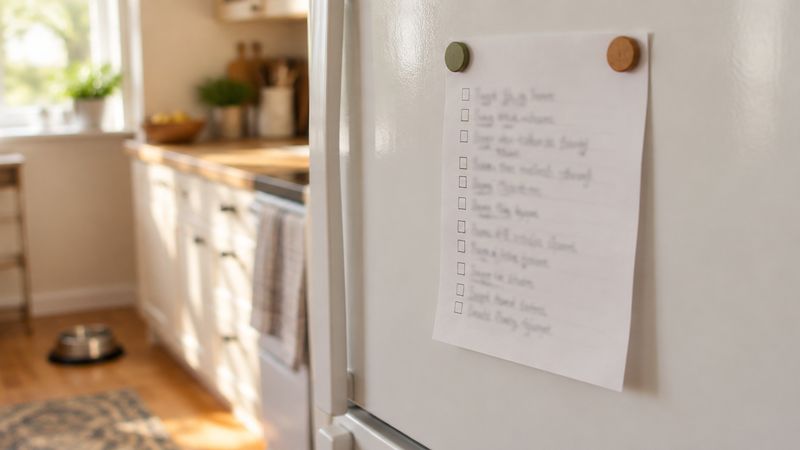
How to do a 10-minute nose-to-tail home health check on your dog
Once a month, spend ten minutes on six checks: body condition, sleeping breathing rate, gums and teeth, skin and coat, paws and nails, and movement. Write the results down and bring them to your veterinarian.
The short version
- A monthly home check covers six areas and takes about ten minutes. It costs nothing.
- On the 9-point body condition scale, the goal for most dogs is 4 to 5.
- A sleeping dog normally takes 15 to 30 breaths per minute. Consistently above 30 is a reason to call your veterinarian.
- For any lump, record location, size, and date. Pea-sized or larger, or present a month, means an appointment.
A monthly home check takes about ten minutes and covers six things: body condition, breathing rate, gums and teeth, skin and coat, paws and nails, and movement. It costs nothing. You need a phone timer and a notebook. VCA Animal Hospitals suggests doing a home check-up monthly, when the dog is relaxed.1
The goal is not to diagnose anything. It is to know what normal looks like for your dog, so a change stands out and reaches your veterinarian with a date on it.
What do you check, and what is normal?
| What to check | What's normal | Write down |
|---|---|---|
| Body condition (ribs, waist, tuck) | Ribs felt without excess fat; waist behind the ribs from above; belly tucked up from the side2 | Score out of 9, plus weight if you have a scale |
| Sleeping breathing rate | 15 to 30 breaths per minute4 | Breaths per minute |
| Gums and teeth | Pink gums, no bumps or ulcers; no loose or broken teeth1 | Color, breath, anything new |
| Skin and coat | No lumps, bumps, or crusty patches1 | Location, size, date of any lump |
| Paws and nails | Pads without cracks; no redness between toes; nails not overlong1 | Date of last trim |
| Movement | Rises and lies down with ease; walks without limping1 | Any stiffness or hesitation |
The 10-minute routine, step by step
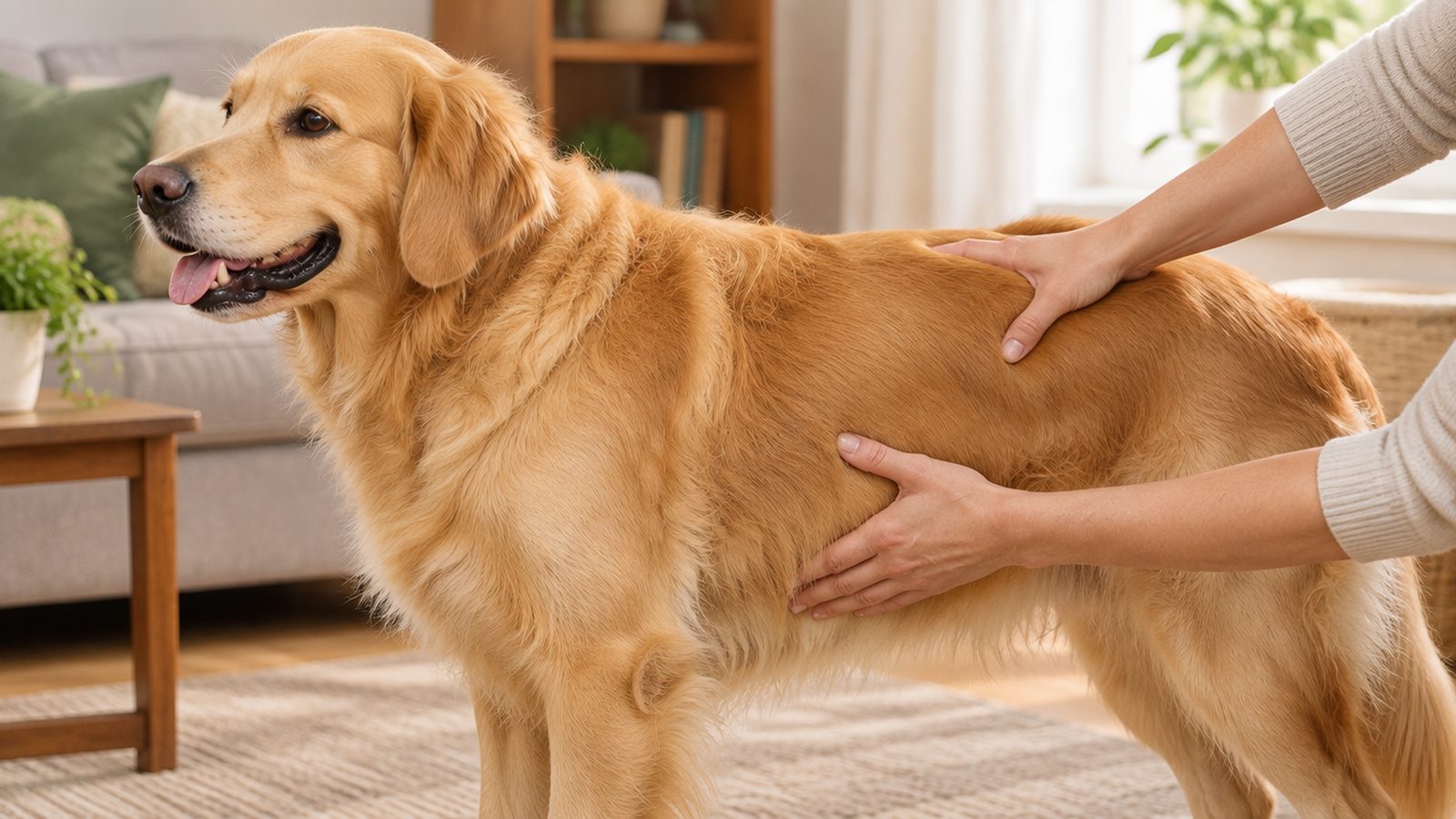
- Body condition, 2 minutes. Run flat hands along the ribcage. Then look down at the dog from above, and from the side. Compare with the 9-point chart below.
- Gums and teeth, 1 minute. Lift the lip gently. Look at gum color and at the teeth. Note the breath.
- Skin and coat, 3 minutes. Stroke slowly over the neck, chest, belly, and each leg, feeling for anything raised. Part the coat where you can and look for fleas, ticks, and crusty spots.1
- Paws and nails, 1 minute. Look at each pad, between the toes, and at nail length.1 VCA says most dogs need a nail trim about once a month, less often if they walk a lot on pavement.7
- Movement, 2 minutes. Watch the dog rise from lying down, walk away from you, and walk back. Look for a limp, stiffness, or hesitation.1
- Breathing rate, 1 minute. Do this one later, when the dog is asleep. See the box below.
How do you score body condition by feel?
Veterinarians use a 9-point body condition score (BCS). The World Small Animal Veterinary Association says the goal for most pets is 4 to 5 out of 9.3 Three reference points from the chart AAHA publishes:2
- 3 of 9, too thin: ribs easily felt and possibly visible, with no fat you can feel.
- 5 of 9, ideal: ribs felt without excess fat covering; a waist behind the ribs when viewed from above; abdomen tucked up.
- 7 of 9, too heavy: ribs felt with difficulty under heavy fat cover; waist absent or barely visible.
VCA's shorthand: you should feel individual ribs without pressing hard.1 Your number may differ from your veterinarian's. Ask them to score the dog at the next visit and show you how they got there.
What should you do when you find a lump?
Write three things: where it is, how big it is next to something familiar such as a pea or a grape, and today's date. A phone photo with a coin beside it helps. Do not squeeze it.
Cornell's Riney Canine Health Center states there is no way to know with certainty what a mass is by looking at it.6 The dated note is what lets your veterinarian judge whether it is changing.
Check tonight
Once your dog is sleeping quietly, watch the chest. One rise and one fall is one breath. Count breaths for 30 seconds and multiply by 2. Texas A&M's cardiology service says dogs, with or without heart disease, generally breathe 15 to 30 times a minute at rest or asleep.4 Write the number and the date. Skip the count if the dog is dreaming, panting, or has just come in from a walk.
When to call your veterinarian
Call right away or go to an emergency clinic:
- Gums that are pale, white, bluish, muddy, or yellow. The Merck Veterinary Manual links these colors to problems such as anemia, shock, low blood oxygen, or liver disease.5
- A raised breathing rate together with coughing, weakness, or collapse.4
Call during office hours:
- A sleeping breathing rate consistently above about 30 per minute.4
- A lump the size of a pea or larger, present for a month or longer, growing, changing, or bleeding.6
- A body condition score that has moved since last month, in either direction.
- A new limp, or trouble getting up or lying down.
What to bring: the notebook. Say, "Here are the monthly numbers, and this is what changed."
What do you bring to the next appointment?
- The monthly page: body condition score, breathing rate, weight if you have it.
- The location, size, and first-seen date of any lump.
- One question: "Does your score match mine, and what should I watch before the next visit?"
Quick answers
What is a normal sleeping breathing rate for a dog?
Texas A&M's veterinary cardiology service says dogs generally breathe 15 to 30 times per minute at rest or asleep. A rate consistently above about 30 per minute is considered increased and is a reason to contact your veterinarian.
How can I tell if my dog is overweight at home?
Feel the ribs and look for a waist. At an ideal body condition score of 5 out of 9, ribs can be felt without excess fat, a waist is visible from above, and the abdomen tucks up. Ribs that are hard to feel and a waist that is absent or barely visible point to about 7 out of 9.
What color should my dog's gums be?
Healthy gums are pink. Pale, white, bluish, muddy, or yellow gums are abnormal and are a reason to contact a veterinarian right away.
Sources
- VCA Animal Hospitals. Giving Your Dog a Thorough Home Check-up
- American Animal Hospital Association. Body Condition Scoring (5-point and 9-point descriptions)
- World Small Animal Veterinary Association / Journal of Small Animal Practice (2011). WSAVA Nutritional Assessment Guidelines
- Texas A&M University Veterinary Medical Teaching Hospital, Cardiology. Client Information Series: Measuring Your Pet's Breathing Rate
- Merck Veterinary Manual. Table: Parameters to Evaluate During Triage
- Cornell University Riney Canine Health Center. Skin lumps and bumps
- VCA Animal Hospitals. How to Trim a Dog's Nails
Written by the Tailwise editorial team from the sources above. We are not veterinarians, and this article is not veterinary advice. If something here matches what you see in your dog, talk to your veterinarian.
More years. Better years.