Doberman Pinscher heart, joints and aging: what to watch and when
Watch the heart, the neck and the waistline. In one European study more than half of Dobermans developed dilated cardiomyopathy, and wobbler syndrome is more common in this breed than in almost any other.
Doberman Pinscher at a glance
The short version
- Dilated cardiomyopathy is the breed's best-documented risk: 58.2% cumulative prevalence in a Munich study of 412 Dobermans.
- Wobbler syndrome, a neck and spinal cord problem, was found in 5.5% of Dobermans in a veterinary database survey; mean age is 6 years.
- OFA rated 6.8% of 22,576 Doberman hip X-rays dysplastic. That sample is owner-submitted, not random.
- UK median lifespan is 11.2 years, so treat a Doberman as a senior from about 8.
A Doberman Pinscher owner should watch three things: the heart, the neck and the waistline. Hips matter too, but the breed's own numbers there are better than most owners expect.
What is a Doberman Pinscher built for?
The breed began in the 1890s in Apolda, Germany, where a tax collector named Louis Dobermann wanted an imposing, dependable dog to protect him on his rounds.1 It later became a police and military working dog.1
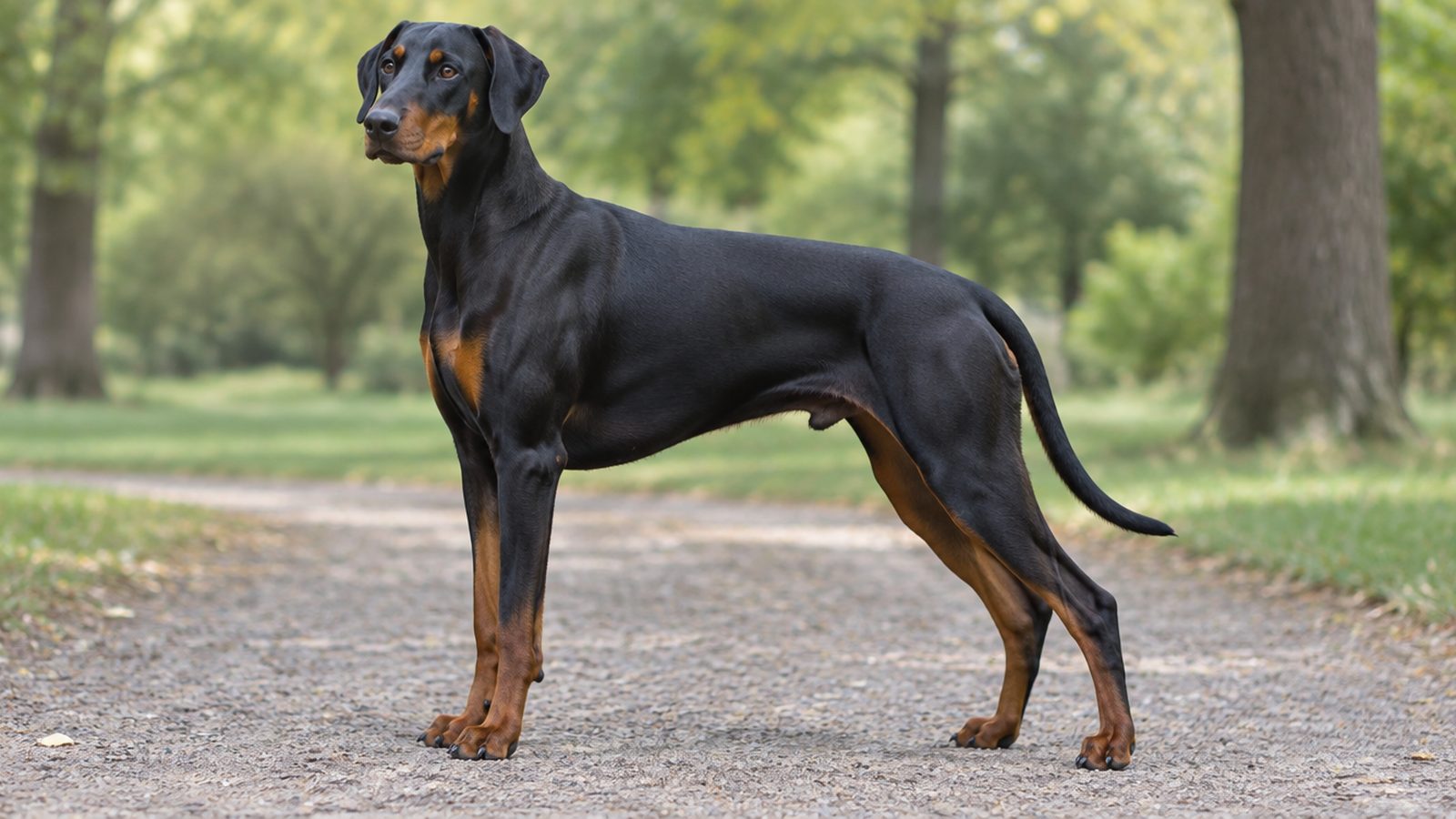
The American Kennel Club (AKC) lists males at 26 to 28 inches and 75 to 100 pounds, and females at 24 to 26 inches and 60 to 90 pounds.1 The standard asks for a short, firm back, a brisket that reaches deep to the elbow and a belly that is well tucked up.1 That is a large, deep-chested athlete. The breed-specific problems on record sit mostly in the neck and the chest.
Which joint and mobility problems are Dobermans prone to?
Two have real breed evidence: wobbler syndrome and, to a smaller degree, hip dysplasia.
| Condition | What it is | When it tends to show |
|---|---|---|
| Wobbler syndrome (cervical spondylomyelopathy) | Compression of the spinal cord and nerves in the neck, causing a wobbly gait, mostly in the back legs2 | Middle-aged to older Dobermans; mean age 6 years2 |
| Hip dysplasia | A hip joint that did not form well | Varies; often found on screening X-rays |
Wobbler syndrome. Ohio State University's veterinary college, which runs a research program on the disease, says Dobermans and Great Danes are the breeds most commonly affected. A survey of the Veterinary Medical Database found it in 5.5% of Dobermans.2 In Dobermans it usually involves a small spinal canal combined with disc herniation.2 The gait change can be subtle. It may show only on slippery floors or when the dog walks slowly, and some dogs carry the head low, which is usually a sign of pain.2 About 5% of affected dogs become suddenly paralyzed in all four legs.2
Hip dysplasia. The Orthopedic Foundation for Animals (OFA) has graded 22,576 Doberman hip X-rays and rated 6.8% dysplastic. Elbows look better still: 0.9% abnormal among 6,495 evaluations.3 OFA numbers come from dogs whose owners chose to submit X-rays, so they are not a random sample of the breed.
How long do Dobermans live, and when is one a senior?
A 2024 study of UK dogs put the breed's median life expectancy at 11.2 years (95% confidence interval 11.0 to 11.5), based on 3,531 Dobermans.5 AKC gives a range of 10 to 12 years.1 UK figures may not match US dogs exactly.
The American Animal Hospital Association defines a senior dog as one in the last 25% of its estimated lifespan.6 Applied to 11.2 years, that is about 8.4 years. That figure is our arithmetic, not a published threshold. Treat a Doberman as a senior from about 8.
What else should a Doberman owner watch?
- Dilated cardiomyopathy (DCM). This heart muscle disease is the breed's best-documented risk. A Munich study that examined 412 Dobermans with ultrasound and 24-hour heart monitors found DCM in 3.3% of dogs aged 1 to 2 years and 43.6% of dogs aged 6 to 8. The cumulative prevalence was 58.2%.4 These were European dogs, and US figures may differ.
- Von Willebrand disease. AKC lists this clotting disorder among the breed's inherited conditions.1 Of 1,966 Dobermans with DNA results in the OFA database, 34.5% were carriers and 6.5% tested abnormal.3
- Bloat. AKC calls it a life-threatening digestive condition and says every Doberman owner should learn its signs.1
What can you do at home?
Weight. It is the part you control. AKC notes that too many treats can cause obesity and suggests checking with your veterinarian if you have any concern about your dog's weight.1 Ask for a body condition score and a target weight at the next visit.
Exercise. AKC describes the Doberman as an energetic athlete who needs a lot of exercise, such as long daily walks or hikes.1 For dogs with wobbler syndrome, Ohio State strongly recommends a chest harness in place of a neck leash.2
Notes for the vet. Write down the date of anything new: stumbling, scuffed toes, a head held low, trouble getting up.
Check tonight
Walk your Doberman slowly across a smooth floor and watch from behind for one minute. Look at the back legs. Do they sway or look unsteady? Is the head carried lower than usual? Write down what you see and the date.
What should you ask your veterinarian?
When to call your veterinarian
- "The Munich researchers recommend yearly heart screening with a Holter monitor and echocardiography from age 2.4 What schedule makes sense for my dog?"
- "Has my dog had the tests the national breed club recommends: hip evaluation, cardiac exam, ophthalmologist evaluation, thyroid evaluation and the von Willebrand DNA test?"1
- "Should we know his von Willebrand status before any surgery?"
- "What is his body condition score, and what weight should we aim for?"
Quick answers
What is the most common health problem in Doberman Pinschers?
Dilated cardiomyopathy, a heart muscle disease, has the strongest breed evidence. A Munich study of 412 Dobermans found a cumulative prevalence of 58.2%. These were European dogs, so US figures may differ.
At what age is a Doberman considered a senior?
From about 8 years. AAHA defines senior as the last 25% of estimated lifespan, and the UK median lifespan for the breed is 11.2 years, which gives about 8.4 years by our arithmetic.
Do Dobermans get hip dysplasia?
Some do. OFA rated 6.8% of 22,576 Doberman hip X-rays as dysplastic. Those X-rays were submitted by owners, so the figure is not a random sample of the breed.
Sources
- American Kennel Club (2026 (accessed)). Doberman Pinscher Dog Breed Information
- The Ohio State University College of Veterinary Medicine (2026 (accessed)). Wobbler Syndrome
- Orthopedic Foundation for Animals (OFA) (2026 (accessed)). Disease Statistics by Breed
- Journal of Veterinary Internal Medicine (2010). Prevalence of Dilated Cardiomyopathy in Doberman Pinschers in Various Age Groups (Wess et al.)
- Scientific Reports (2024). Longevity of companion dog breeds: those at risk from early death (McMillan et al.)
- American Animal Hospital Association (2019). Canine Life Stage Definitions (2019 AAHA Canine Life Stage Guidelines)
- American College of Veterinary Surgeons (2026 (accessed)). Gastric Dilatation-Volvulus
Written by the Tailwise editorial team from the sources above. We are not veterinarians, and this article is not veterinary advice. If something here matches what you see in your dog, talk to your veterinarian.
More years. Better years.