German Shorthaired Pointer joints, bloat and aging: what to watch and when
A German Shorthaired Pointer owner should watch for bloat first. Inherited joint disease is less common in this breed than in most, though not absent.
German Shorthaired Pointer at a glance
The short version
- In OFA records, 3.9% of evaluated GSPs had dysplastic hips and 0.8% had dysplastic elbows, among the lowest of 60 breeds.
- The AKC says the breed is subject to bloat, which is an emergency.
- UK median lifespan is 13.4 years; the AKC gives 10 to 12. Senior starts somewhere between 8 and 10.
- Breed-specific data on other joint conditions are thin, and we say so.
A German Shorthaired Pointer owner should watch for bloat first, then eyes and heart, and keep an athletic dog lean. On inherited joint disease, this breed's registry numbers are among the lowest on record.14
What is a German Shorthaired Pointer built for?
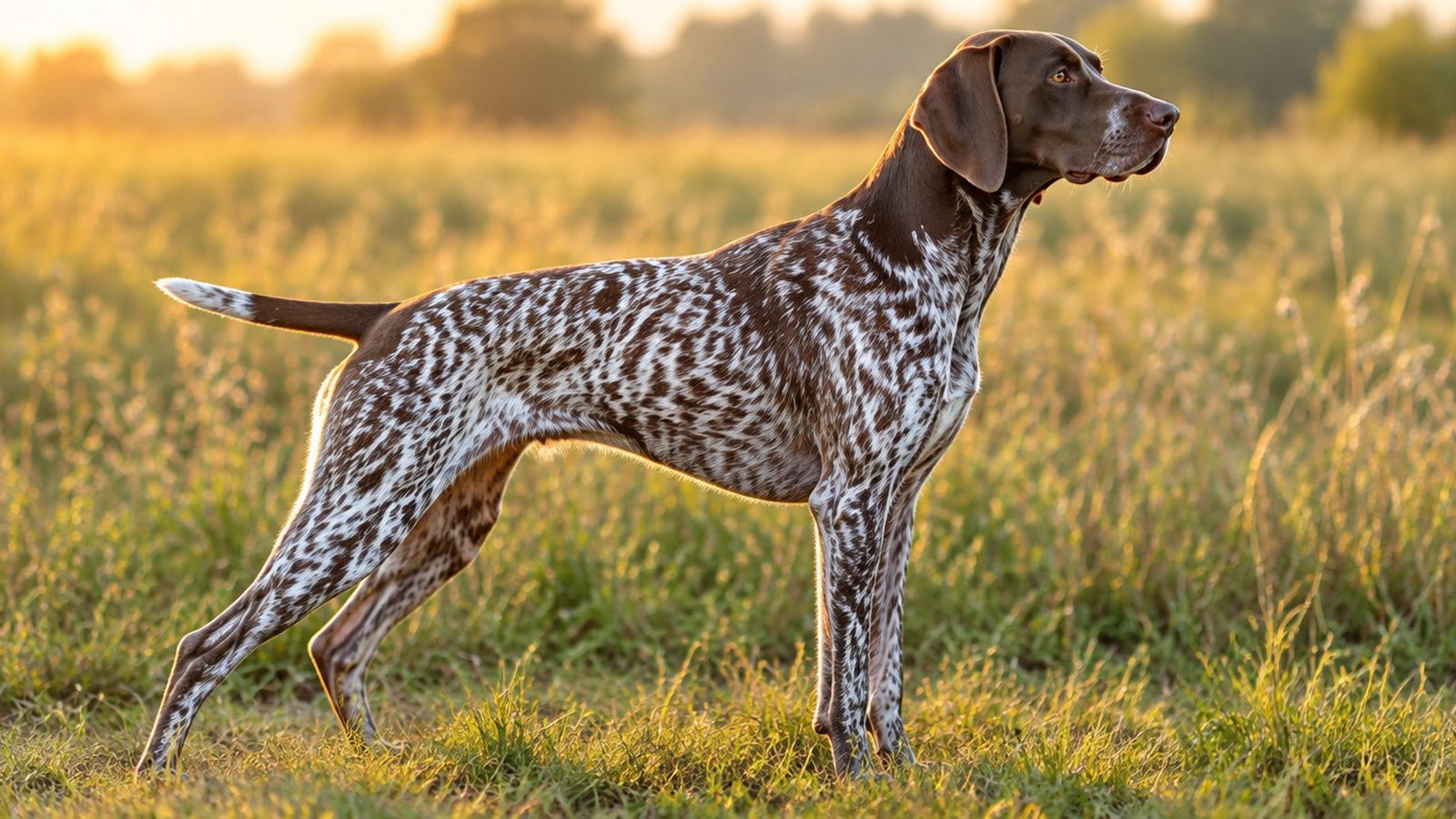
German hunters developed the breed in the 1800s as a do-everything bird dog: pointing, trailing and retrieving on land and in water.1 The AKC puts males at 23 to 25 inches and 55 to 70 pounds, and females at 21 to 23 inches and 45 to 60 pounds.1
The AKC describes a dog built to work long days in the field or at the lake, known for power, speed, agility and endurance.1 That means a medium-to-large frame that is meant to stay lean and moving. It also means a dog whose joints are asked to do a lot, every day, for many years.
Which joint and mobility problems are German Shorthaired Pointers prone to?
Fewer than most breeds, on the evidence available. Two conditions have breed-specific numbers.
Hip dysplasia. The hip joint forms loosely and wears over time. In Orthopedic Foundation for Animals (OFA) records from 1970 to 2015, 3.9% of evaluated GSPs had dysplastic hips. That was one of the four lowest rates among the 60 breeds studied.4
Elbow dysplasia. The bones of the elbow fit poorly and the joint wears. In the same records, 0.8% of evaluated GSPs had dysplastic elbows.4
Two cautions. OFA data come from dogs whose owners submitted X-rays, counted at age 2 or older, so they are not a random sample.4 And a low breed rate is not zero for your dog. The AKC still lists hip dysplasia among the conditions the breed may be prone to, and the parent club's CHIC program requires hip and elbow evaluations at a minimum of 24 months.15
Where the data are thin: we did not find large breed-specific studies of cruciate ligament disease or osteochondrosis in GSPs, so we are not listing them as breed risks.
| Condition | What it is | When it tends to show |
|---|---|---|
| Hip dysplasia | Loose hip joint that wears | Signs as early as a few months old, or not until later in life7 |
| Elbow dysplasia | Elbow bones fit poorly | Develops during growth; OFA evaluates at 24 months5 |
How long do German Shorthaired Pointers live, and when is one a senior?
A 2024 UK study of more than 584,000 dogs puts the GSP median at 13.4 years (95% confidence interval 13.3 to 13.6), above the 12.5-year median for all dogs.2 The AKC gives a shorter range, 10 to 12 years.1 UK data may differ from US dogs.
AAHA defines senior as the last 25% of estimated lifespan.3 Our arithmetic: 13.4 times 0.75 is about 10. Using the AKC range gives 7.5 to 9. So a GSP becomes a senior somewhere between 8 and 10.
What else should a German Shorthaired Pointer owner watch?
- Bloat (GDV). The AKC says GSPs can be affected by bloat, where the stomach suddenly distends and often twists.1 ACVS calls it rapidly progressive and life-threatening, and names a deep chest as a risk factor.6
- Eyes. The parent club requires a DNA test for cone degeneration and an eye exam by a veterinary ophthalmologist every year until age 6.5
- Heart. The AKC lists certain heart diseases among breed concerns, and the club requires a cardiac exam at 24 months or older.15
What can you do at home?
Keep him lean. Cornell names maintaining a healthy body weight as essential in managing hip dysplasia, along with regular low-impact exercise such as walking and swimming.7
Give him real work. The AKC suggests ample activity twice a day, such as brisk half-hour walks morning and evening, or running in a fenced area.1 Time meals around it: the AKC advises not feeding right after vigorous exercise, and no running for at least an hour after eating and drinking.1
Check tonight
After your GSP has rested for an hour, call him to you and watch the first ten steps. Note any stiffness in the back legs, a shortened stride, or reluctance to jump up. Then watch him run: do the back legs move together in a "bunny hop"? Cornell lists these among the signs of hip dysplasia.7 Write down what you see.
What should you ask your veterinarian?
When to call your veterinarian
Bloat cannot wait. Go to a veterinarian or emergency clinic immediately if you see the signs ACVS lists:6
- Retching without bringing anything up
- A swollen, tight abdomen
- Drooling, panting and anxious pacing
- Weakness or collapse
Questions worth asking:
- What is his body condition score, and is his weight right for his workload?
- Has he had, or should he have, the club's CHIC tests: hips, elbows, cardiac exam, eye exam and the cone degeneration DNA test?5
- What is his bloat risk, and what should our emergency plan be?
- Where is the nearest after-hours clinic?
Quick answers
Do German Shorthaired Pointers get hip dysplasia?
Some do, but less often than most breeds. In OFA records from 1970 to 2015, 3.9% of evaluated GSPs had dysplastic hips, one of the lowest rates among 60 breeds. Those figures come from owner-submitted X-rays.
How long do German Shorthaired Pointers live?
A 2024 UK study put the median at 13.4 years. The AKC gives a range of 10 to 12 years. UK data may differ from US dogs.
Are German Shorthaired Pointers prone to bloat?
The AKC says the breed is subject to bloat. Unproductive retching with a swollen abdomen is an emergency that needs a veterinarian immediately.
Sources
- American Kennel Club (2026 (accessed)). German Shorthaired Pointer Dog Breed Information
- Scientific Reports (Nature Portfolio) (2024). Longevity of companion dog breeds: those at risk from early death (McMillan et al., Scientific Reports; breed medians in Supplementary Table S3)
- American Animal Hospital Association (2019). Canine Life Stage Definitions (2019 AAHA Canine Life Stage Guidelines)
- PLOS ONE (2017). Long-term genetic selection reduced prevalence of hip and elbow dysplasia in 60 dog breeds (Oberbauer et al.)
- German Shorthaired Pointer Club of America (2026 (accessed)). CHIC (Canine Health Information Center) requirements
- American College of Veterinary Surgeons (2026 (accessed)). Gastric Dilatation-Volvulus
- Cornell University College of Veterinary Medicine, Riney Canine Health Center (2026 (accessed)). Canine hip dysplasia (CHD)
Written by the Tailwise editorial team from the sources above. We are not veterinarians, and this article is not veterinary advice. If something here matches what you see in your dog, talk to your veterinarian.
More years. Better years.