German Shepherd joints, weight and aging: what to watch and when
Watch hips, elbows and hind-leg strength, keep the dog lean, and learn the signs of bloat. A German Shepherd is a senior from about 8 years.
German Shepherd Dog at a glance
The short version
- Main mobility risks: hip dysplasia, elbow dysplasia and degenerative myelopathy.
- In a UK study of 12,146 dogs, 5.5% had arthritis and 2.7% hip dysplasia recorded in one year.
- UK median lifespan is 10.3–11.3 years depending on the dataset; AKC states 12–14. Senior from about 8.
- Bloat is an emergency: retching with nothing coming up and a swelling belly mean go now.
A German Shepherd owner should watch the back end: hips, elbows and, later in life, hind-leg strength. Add one emergency to know by heart, which is bloat.
What is a German Shepherd built for?
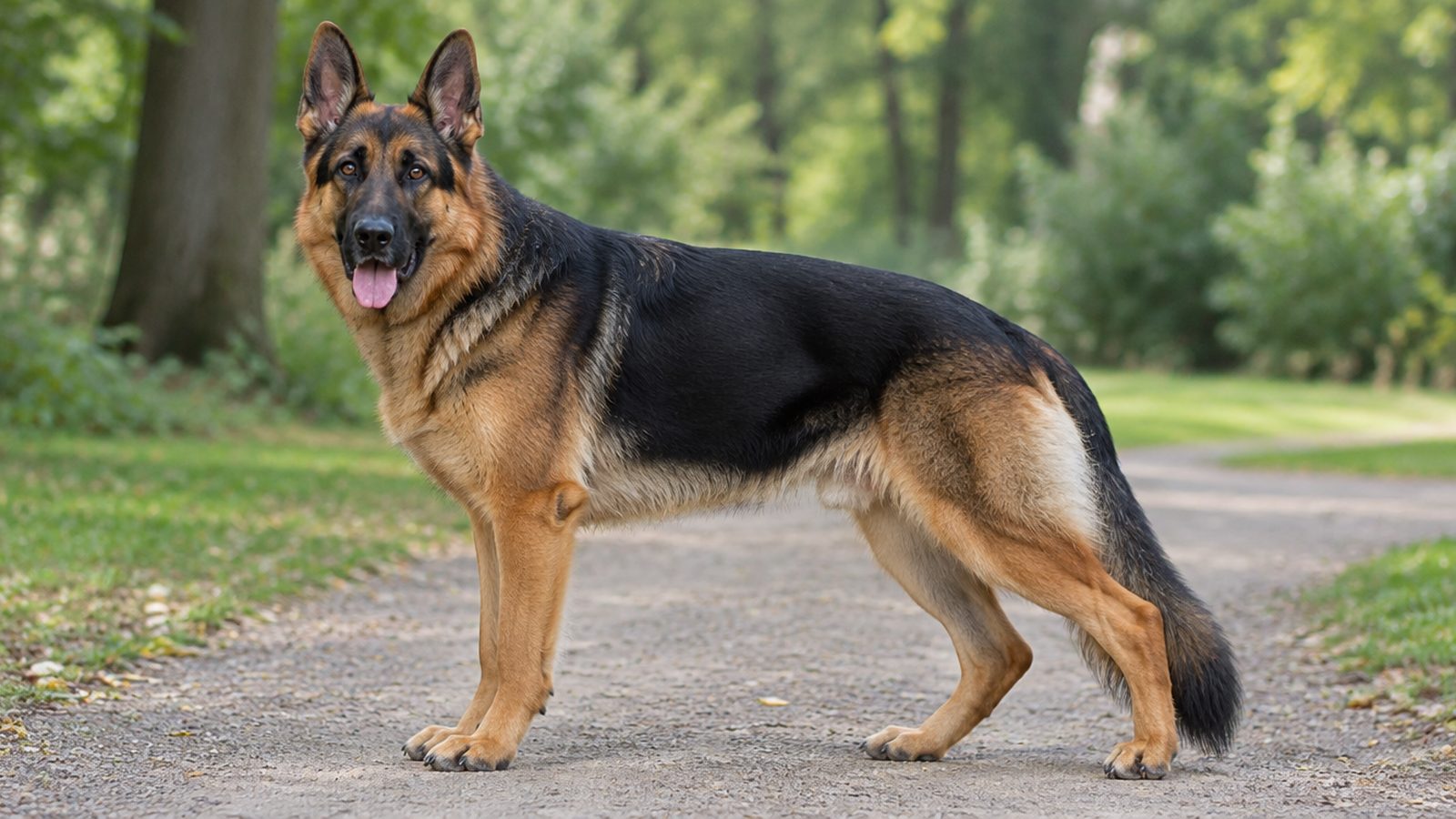
The German Shepherd Dog was created to herd sheep. In the late 1800s a German cavalry officer, Captain Max von Stephanitz, crossed regional herding strains to build one ideal herder. As herding declined, he promoted the breed for police and military work, where it remains a first choice.1
The American Kennel Club describes males at 24–26 inches and 65–90 pounds, females at 22–24 inches and 50–70 pounds.1 It is a large, very active dog. In a UK study of 12,146 German Shepherds in general veterinary practice, average adult weight was 36 kg for males and 31 kg for females, about 79 and 68 pounds.3 Hips and elbows carry that load every day.
Which joint and mobility problems are German Shepherds prone to?
AKC says responsible breeders screen for hip dysplasia, elbow dysplasia and degenerative myelopathy.1 Those are the three to know.
| Condition | What it is | When it tends to show |
|---|---|---|
| Hip dysplasia | A loose-fitting hip joint that damages cartilage and leads to arthritis6 | Looseness in puppies; arthritis in mature dogs. Many dogs show no signs6 |
| Elbow dysplasia | A developmental elbow problem that AKC lists as a breed screen1 | Usually found in young, growing dogs |
| Degenerative myelopathy | An inherited nerve disease with progressive hind-limb weakness and muscle loss5 | Usually at 8 years or older5 |
In the UK study, 5.5% of German Shepherds were recorded with arthritis and 2.7% with hip dysplasia in a single year.3 Joint disorder and being unable to stand were among the most common recorded reasons for death, alongside cancer and spinal disease.3 We could not read OFA's X-ray statistics for this article. When you do see OFA percentages, remember they come from dogs whose owners chose to submit X-rays, not a random sample.
Degenerative myelopathy is linked to a mutation in the SOD1 gene. A dog needs two copies to be at risk, and UC Davis notes that not every dog with two copies develops the disease.5 Affected dogs slowly lose coordination in the hind legs and may be unable to walk 6 months to 2 years after signs begin.5
How long do German Shepherds live, and when is one a senior?
Figures differ by dataset. A UK analysis of 19,908 German Shepherds found a median life expectancy of 11.3 years.2 The UK veterinary-practice study found 10.3 years.3 AKC states 12–14 years.1 US dogs may differ from UK dogs.
AAHA defines senior as the last 25% of estimated lifespan.4 By our arithmetic, that starts at about 7.5 to 8.5 years on the UK figures. Plan senior checks from around 8.
What else should a German Shepherd owner watch?
- Bloat (gastric dilatation-volvulus). AKC warns that German Shepherds can experience bloat and that owners should learn the signs.1 The stomach swells and may twist. It is rapidly progressive, life-threatening and needs immediate care.7
- Ear infections. The most common disorder in the UK study, recorded in 7.9% of dogs in one year.3
- Weight. 5.2% were recorded as overweight or obese in a year, and 2.7% as underweight.3
What can you do at home?
Keep your dog lean. The American College of Veterinary Surgeons says dogs with hip dysplasia should be kept very slim from a young age into old age, and calls it the most effective and least expensive long-term measure.6
This is an athletic breed that needs a lot of exercise for body and mind. With a puppy, AKC suggests starting with short daily walks and play in a fenced area.1 For the vet, write down what you see and when: slow to rise, hind paws scuffing, nails wearing unevenly, a sway in the back end.
Check tonight
On the evening walk, drop a few steps behind and watch the hind legs for one minute on a flat, hard surface. Listen for nails scraping the ground and look for a paw that drags or knuckles over, or hips that sway. Then check the tops of the two middle nails on each hind foot for flat, worn spots. Write down what you see.
What should you ask your veterinarian?
When to call your veterinarian
- Now, at any hour: retching with nothing coming up, a swelling belly, drooling, restlessness or standing and stretching, weakness or collapse. These are the signs ACVS lists for bloat.7
- Within a few days: hind paws dragging or scuffing, wobbling, trouble rising, or a limp that lasts more than a day or two.
- "Is my dog at a lean body condition, and what weight should we aim for?"
- "Should we X-ray hips and elbows?" The breed club's listed tests are hip and elbow evaluations and a temperament test.1
- "Is a DNA test for degenerative myelopathy useful for my dog?"
- "What should I do, and where should I go, if I see signs of bloat at night?"
Quick answers
What health problems are German Shepherds prone to?
Hip dysplasia, elbow dysplasia and degenerative myelopathy are the main mobility risks. The breed can also experience bloat, which is an emergency, and ear infections were the most common disorder in a UK study of 12,146 dogs.
How long do German Shepherds live?
UK datasets put the median at 10.3 to 11.3 years. The American Kennel Club states 12–14 years. US and UK figures may differ.
At what age does degenerative myelopathy start in German Shepherds?
UC Davis reports that affected dogs usually show signs in adulthood, at 8 years or older, starting with weakness and loss of coordination in the hind legs. Not every dog with two copies of the SOD1 mutation develops the disease.
Sources
- American Kennel Club. German Shepherd Dog Breed Information
- Dogs Trust (2024). Life expectancy for 155 breeds and crossbred group (breed table for McMillan et al., Longevity of companion dog breeds, Scientific Reports)
- Royal Veterinary College VetCompass (2017). German Shepherd Dogs: health study results (infographic for O'Neill et al. 2017, Demography and disorders of German Shepherd Dogs under primary veterinary care in the UK, Canine Genetics and Epidemiology)
- American Animal Hospital Association (2019). Canine Life Stage Definitions (2019 AAHA Canine Life Stage Guidelines)
- UC Davis Veterinary Genetics Laboratory. Degenerative Myelopathy (DM)
- American College of Veterinary Surgeons. Canine Hip Dysplasia
- American College of Veterinary Surgeons. Gastric Dilatation-Volvulus
Written by the Tailwise editorial team from the sources above. We are not veterinarians, and this article is not veterinary advice. If something here matches what you see in your dog, talk to your veterinarian.
More years. Better years.