Dachshund back, weight and aging: what to watch and when
Watch the back first and weight second. Disc disease affects roughly 1 in 4 Dachshunds, usually in mid-life, and sudden signs need a same-day call.
Dachshund at a glance
The short version
- Intervertebral disc disease is the main risk; Dachshunds make up 45–70% of all IVDD cases.
- In a survey of 2,031 Dachshunds, 15.7% had diagnosed IVDD, at an average age of 5.4 years.
- UK median lifespan is 13.2 years (14.0 for miniatures); senior from about 10.
- Sudden reluctance to move, crying when lifted or wobbly back legs means call the same day.
A Dachshund owner should watch the back first, and weight second because it loads the back. Most back trouble in this breed shows up in middle age, often suddenly, and early signs are easy to miss.
What is a Dachshund built for?
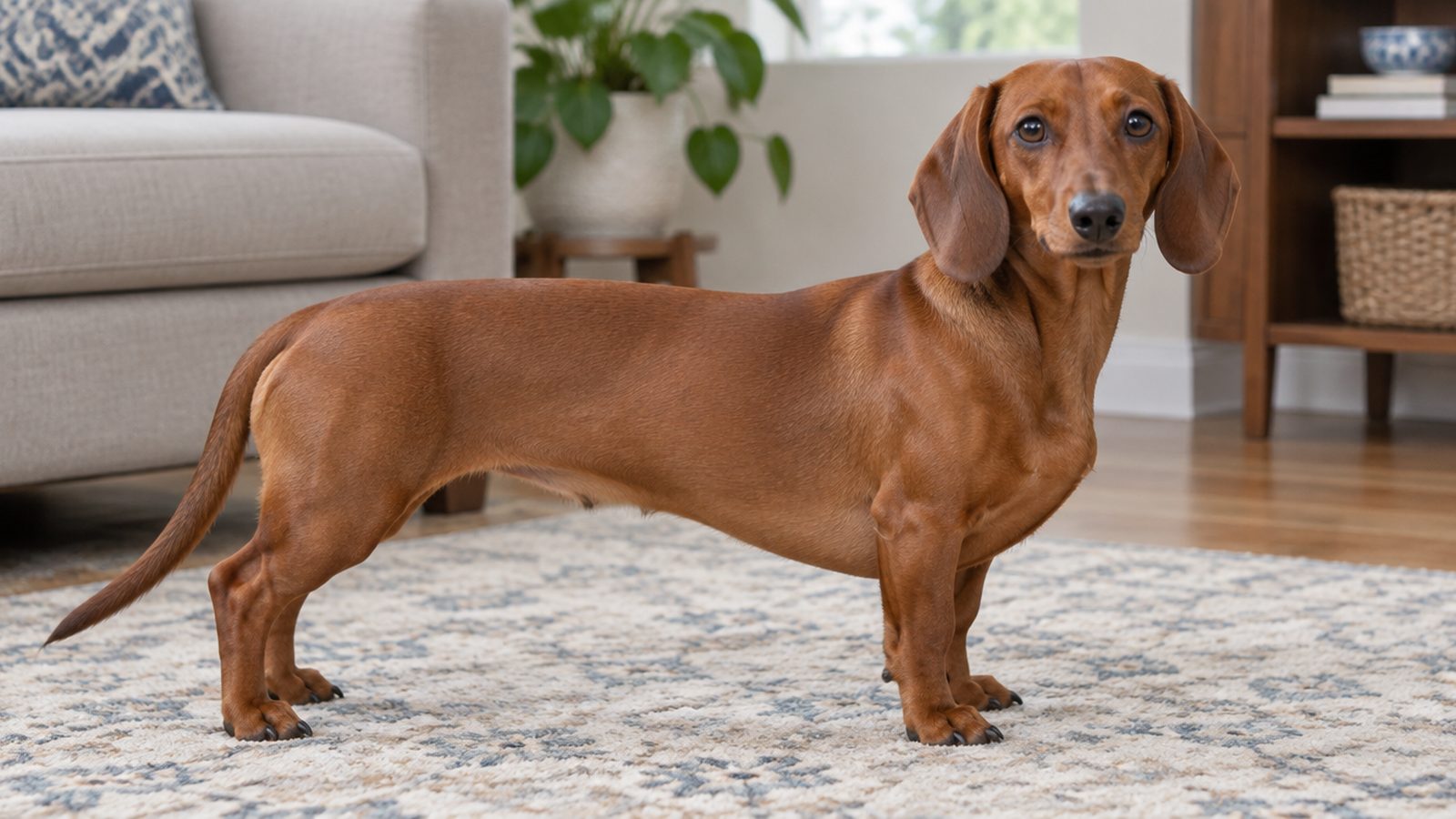
"Dachshund" is German for "badger dog." The breed's history goes back about 600 years, and the long, low body was developed to dig into a badger den.1 The American Kennel Club recognizes two sizes: standards, usually 16–32 pounds and 8–9 inches tall, and miniatures, 11 pounds and under and 5–6 inches tall.1
The short legs come from a known genetic change. The same change, called chondrodystrophy (CDDY), also causes the discs between the vertebrae to degenerate early.4 So the shape that makes a Dachshund a Dachshund is also what puts the spine at risk.
Which back and joint problems are Dachshunds prone to?
One condition dominates: intervertebral disc disease (IVDD). A disc swells or ruptures and presses on the spinal cord.6
| Condition | What it is | When it tends to show |
|---|---|---|
| Intervertebral disc disease | A degenerated disc bulges or ruptures against the spinal cord, causing pain, wobbliness or paralysis6 | Most often 3–6 years in short-legged breeds;6 average age at diagnosis 5.4 years in a Dachshund survey5 |
| Patellar luxation | A kneecap that slips out of its groove | The breed club lists a patella evaluation;1 we found no Dachshund-specific figure |
The numbers that apply to your dog:
- The American College of Veterinary Surgeons says Dachshunds alone account for 45–70% of all IVDD cases.6
- The UK Dachshund screening programme estimates that 1 in 4 Dachshunds will have some degree of back disease in their lifetime, about 10–12 times the rate expected in dogs generally.7
- In an owner survey of 2,031 Dachshunds, 15.7% had veterinary-diagnosed IVDD. Standard smooth-haired dogs were highest at 24.4% and standard wire-haired lowest at 7.1%.5 In 41.7% of cases, signs came on in under 24 hours.5
- At the UC Davis genetics lab, more than 1,000 Dachshunds tested had a CDDY allele frequency of about 0.92. In dogs with CDDY, the disc centers begin to calcify between birth and 1 year of age.4
In other words, nearly every Dachshund carries the risk. Most never have a serious episode.
How long do Dachshunds live, and when is one a senior?
A large UK analysis put median life expectancy at 13.2 years for Dachshunds and 14.0 years for Miniature Dachshunds.2 AKC states 12–16 years.1 UK and US dogs may differ.
AAHA defines senior as the last 25% of estimated lifespan.3 By our arithmetic, that starts at about 10 years for a standard and 10.5 for a miniature. Note that the peak years for disc trouble come well before that, in mid-life.
What else should a Dachshund owner watch?
- Weight. AKC calls it extremely important that a Dachshund not become overweight, because extra weight strains the long back.1
- Ears. Like most dogs with drop ears, Dachshunds can get ear infections if the ears are not kept clean.1
Dental disease is often mentioned for small breeds. We did not find a Dachshund-specific figure, so ask your veterinarian to look at the teeth at each visit.
What can you do at home?
Keep your Dachshund lean and well muscled. AKC recommends two walks of moderate length a day to build the muscles that support the back, and advises against letting a Dachshund run up and down stairs or jump on and off furniture.1
The survey data point the same way on exercise: dogs walked more than an hour a day had lower odds of IVDD, and dogs walked under 30 minutes had higher odds.5 That is an association from owner reports. It cannot show cause, and dogs with back trouble may simply have been exercised less.
Check tonight
Watch your Dachshund walk away from you across a hard floor for one minute, then watch him step down a single low step or curb. Look for a hunched back, a head carried low, back feet that cross, wobble or scuff, or a pause before the step that was not there last month. Do not press on the spine. Write down what you see.
What should you ask your veterinarian?
When to call your veterinarian
Call the same day if your Dachshund suddenly does not want to move, cries when picked up, holds the back hunched or the neck stiff, or walks wobbly in the back legs. If the back legs stop working or he loses bladder control, go to an emergency clinic now. ACVS describes disc rupture as a surgical emergency, and the outlook is better while the dog can still feel the legs.6
- "Is my dog at a lean body condition, and what weight should we aim for?"
- "What early signs of disc disease should I watch for, and what do I do out of hours?"
- "Are stairs, jumping and my current exercise routine right for this dog?"
- "Should we check knees, heart and eyes?" The breed club's listed tests are a patella evaluation, a cardiac exam and an eye exam.1
Quick answers
How common are back problems in Dachshunds?
The UK Dachshund screening programme estimates 1 in 4 Dachshunds will have some degree of back disease in their lifetime. In an owner survey of 2,031 Dachshunds, 15.7% had veterinary-diagnosed intervertebral disc disease.
At what age do Dachshunds get IVDD?
Most often in mid-life. The American College of Veterinary Surgeons gives 3–6 years for short-legged breeds, and the average age at diagnosis in a Dachshund survey was 5.4 years.
How long do Dachshunds live?
A UK analysis found a median of 13.2 years for Dachshunds and 14.0 years for Miniature Dachshunds. The American Kennel Club states 12–16 years.
Sources
- American Kennel Club. Dachshund Dog Breed Information
- Dogs Trust (2024). Life expectancy for 155 breeds and crossbred group (breed table for McMillan et al., Longevity of companion dog breeds, Scientific Reports)
- American Animal Hospital Association (2019). Canine Life Stage Definitions (2019 AAHA Canine Life Stage Guidelines)
- UC Davis Veterinary Genetics Laboratory. Chondrodystrophy (CDDY and IVDD Risk) and Chondrodysplasia (CDPA)
- Canine Genetics and Epidemiology (2016). DachsLife 2015: an investigation of lifestyle associations with the risk of intervertebral disc disease in Dachshunds (Packer et al.)
- American College of Veterinary Surgeons. Intervertebral Disc Disease
- Dachshund Health UK (Dachshund IVDD screening programme). How common is IVDD?
Written by the Tailwise editorial team from the sources above. We are not veterinarians, and this article is not veterinary advice. If something here matches what you see in your dog, talk to your veterinarian.
More years. Better years.