Why does my dog stare at me?
Mostly your dog is asking for something or checking in, and in a relaxed dog that eye contact is part of how you bond. A fixed stare with a stiff body, or an older dog staring into space, means something else.
The short version
- Dogs look to human faces when they need something; socialized wolves in the same test did not.
- In a 2015 study, dog-owner pairs that shared long gazes showed a rise in oxytocin in both. The finding has known limits.
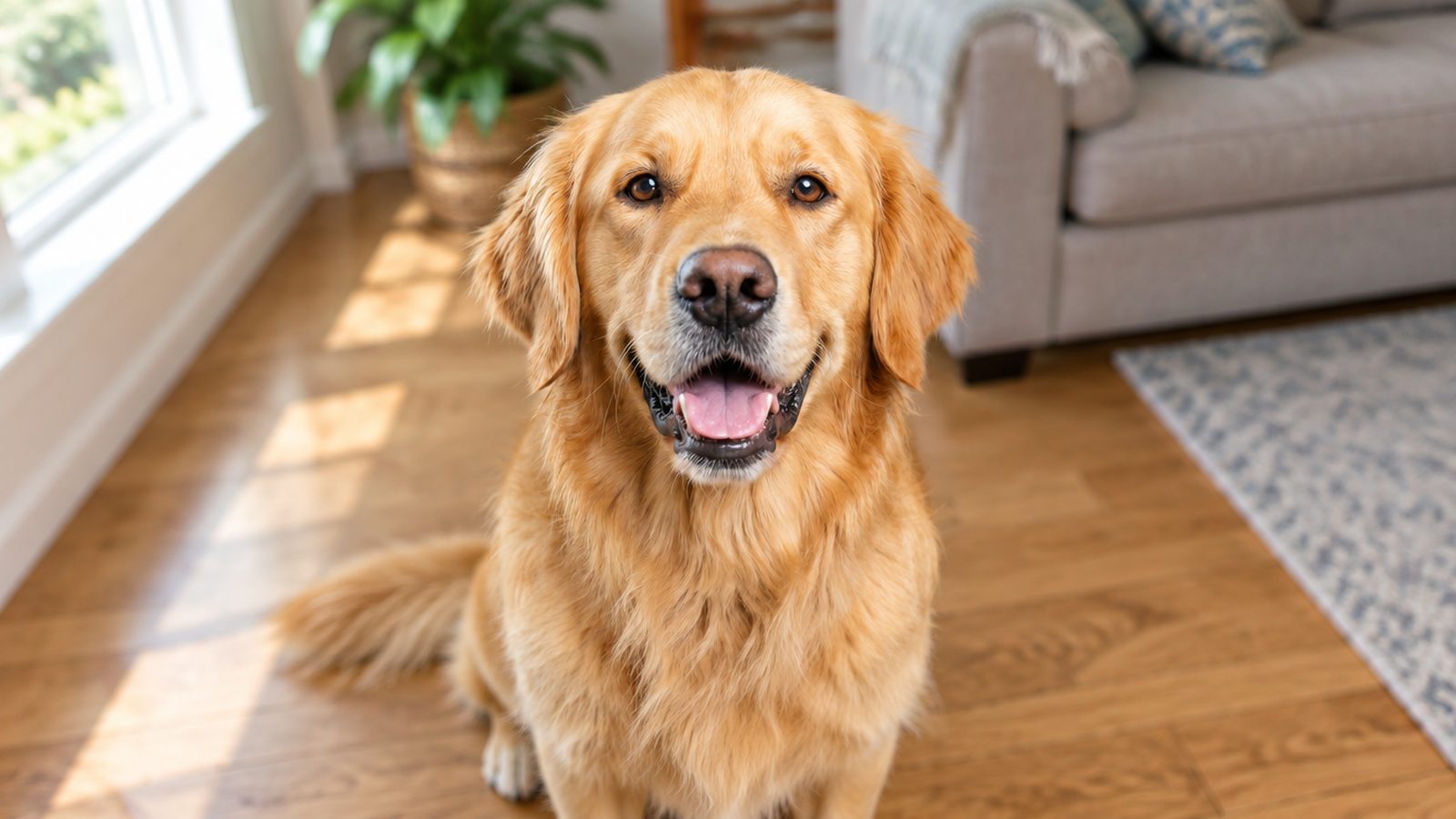
- A soft gaze has relaxed lids and a loose body. A hard stare is wide, fixed and comes with a stiff body.
- An older dog staring into space or getting stuck in corners is worth a veterinary visit.
Your dog stares at you mostly to ask for something or to check what you will do next, and in a relaxed dog that eye contact is also part of how the two of you bond. What matters is the rest of the picture: the eyelids, the body, and what is going on around the stare.
What is your dog asking for when it stares?
Looking at a human face is something dogs do and wolves largely do not. In a 2003 study in Current Biology, dogs and human-socialized wolves were first trained on a simple task and then given a version that could not be solved. The dogs looked at the person. The wolves did not. The authors concluded that the key difference between the two species is the dog's readiness to look at a human face, and that this habit is what dog-human communication is built on.1
So a stare is often a question addressed to you. Context usually tells you which one:
- Near the bowl, the treat jar or your plate: food.
- By the door or the leash: out.
- With a toy at your feet: play.
- During a walk or training: waiting for the next cue.
Does eye contact really bond you and your dog?
There is evidence that it does, with caveats. In a 2015 study in Science, dogs spent 30 minutes with their owners. In the pairs that exchanged long gazes, oxytocin rose in both the owner and the dog. In pairs that shared only short gazes, it stayed flat. Hand-raised wolves and their owners did not show the effect.23 The authors described this as a positive loop between gaze and oxytocin, a hormone tied to social attachment.2
The finding has limits. A published commentary pointed out that only the long-gaze dogs showed the effect, that all the dogs tested were adults, and that the conclusion about how the trait evolved was premature.3 A fair reading: calm, mutual eye contact goes together with a bonding hormone in some dogs and their owners.
Why are a dog's eyes so easy to read?
Part of the answer is anatomy. A 2019 study in PNAS compared dissected dog and wolf heads and found that a small muscle that raises the inner eyebrow, the levator anguli oculi medialis, is uniformly present in dogs but not in wolves. Dogs also made the eyebrow movement more often and more intensely than wolves. The movement makes the face look more infant-like and resembles an expression people make when sad. The authors' hypothesis is that people favored dogs with expressive eyebrows, and that preference shaped the face over about 33,000 years of domestication.4
How is a soft gaze different from a hard stare?
These are two different signals, and the eyes alone will not tell you which one you are seeing. Read the eyes together with the body.
| Soft gaze | Hard stare | |
|---|---|---|
| Eyes | Relaxed lids, sometimes close to a squint5 | Wide open, fixed, held for a long time56 |
| Body | Loose, weight even | Stiff limbs, tense muscles, weight shifted forward6 |
| What it signals | Calm or happy5 | Usually a threat or a warning56 |
Two related signals are worth knowing. A dog that shows the whites of its eyes is anxious or stressed. A dog that pointedly looks away is trying to calm a situation down.5
If you get a hard stare with a stiff body, for example over a food bowl, a chew or a resting spot, do not stare back and do not reach in. Give the dog space and mention it to your veterinarian.
Check tonight
The next time your dog stares at you this evening, take one minute and note three things before you respond:
- Eyes: relaxed lids, or wide and fixed?
- Body: loose, or stiff and still?
- Context: what is nearby (bowl, door, leash, toy) and what happened in the last five minutes?
Then give your best guess at the request and see if you were right.
When is staring a reason to talk to your veterinarian?
A stare aimed at you is communication. A stare aimed at nothing is a different thing, especially in an older dog. Cornell's Riney Canine Health Center lists "staring into space," getting stuck in corners and getting lost in familiar places among the disorientation signs of cognitive dysfunction syndrome, which dogs may start to develop at around nine years of age or older.7
When to call your veterinarian
Book a visit if your dog, particularly a senior:
- stares at walls, corners or empty space, or seems lost at home;
- also wanders at night, has started soiling indoors, or no longer responds to cues it knew;7
- gives hard, fixed stares with a stiff body, or this is new behavior.
Tell the veterinarian what you saw, how often, at what time of day, and when it started. Expect a physical exam and possibly blood and urine tests, because other conditions can produce similar signs.7
Should you stare back?
With your own relaxed dog, soft eye contact is fine and is the kind of gaze the bonding research describes.2 Keep your own face loose and let the dog look away when it wants to. With a dog you do not know, skip the direct eye contact. In dog communication, a direct wide-eyed stare is a threat.6
Quick answers
Why does my dog stare at me without blinking?
Usually it wants something or is waiting for your next move. Look at the rest of the dog: relaxed eyelids and a loose body mean a calm request, while wide fixed eyes with a stiff body are a warning and the dog should be given space.
Is it bad to stare into my dog's eyes?
Soft eye contact with your own relaxed dog is fine and is linked in research to oxytocin release in some dog-owner pairs. Avoid direct staring at unfamiliar dogs, because a direct wide-eyed stare is a threat signal in dog communication.
Why does my old dog stare at the wall?
Staring into space and getting stuck in corners are listed signs of cognitive dysfunction syndrome, which can begin at around nine years of age or older. Other conditions can look similar, so describe what you see to your veterinarian.
Sources
- Current Biology, abstract via WellBeing International Studies Repository (2003). A Simple Reason for a Big Difference: Wolves Do Not Look Back at Humans, but Dogs Do (Miklósi et al., Current Biology 13(9):763-766)
- Science, record and abstract via CARTA (2015). Oxytocin-gaze positive loop and the coevolution of human-dog bonds (Nagasawa et al., Science 348:333-336)
- Frontiers in Psychology (2015). Commentary: Oxytocin-gaze positive loop and the coevolution of human-dog bonds
- PNAS, abstract via University of Portsmouth research portal (2019). Evolution of facial muscle anatomy in dogs (Kaminski et al., PNAS)
- American Kennel Club (2025). Understanding Dog Body Language: Decipher Dogs' Signs & Signals
- VCA Animal Hospitals. Canine Communication - Interpreting Dog Language
- Cornell University, Riney Canine Health Center. Cognitive dysfunction syndrome
Written by the Tailwise editorial team from the sources above. We are not veterinarians, and this article is not veterinary advice. If something here matches what you see in your dog, talk to your veterinarian.
Better days ahead.