
Why does my dog lean on me?
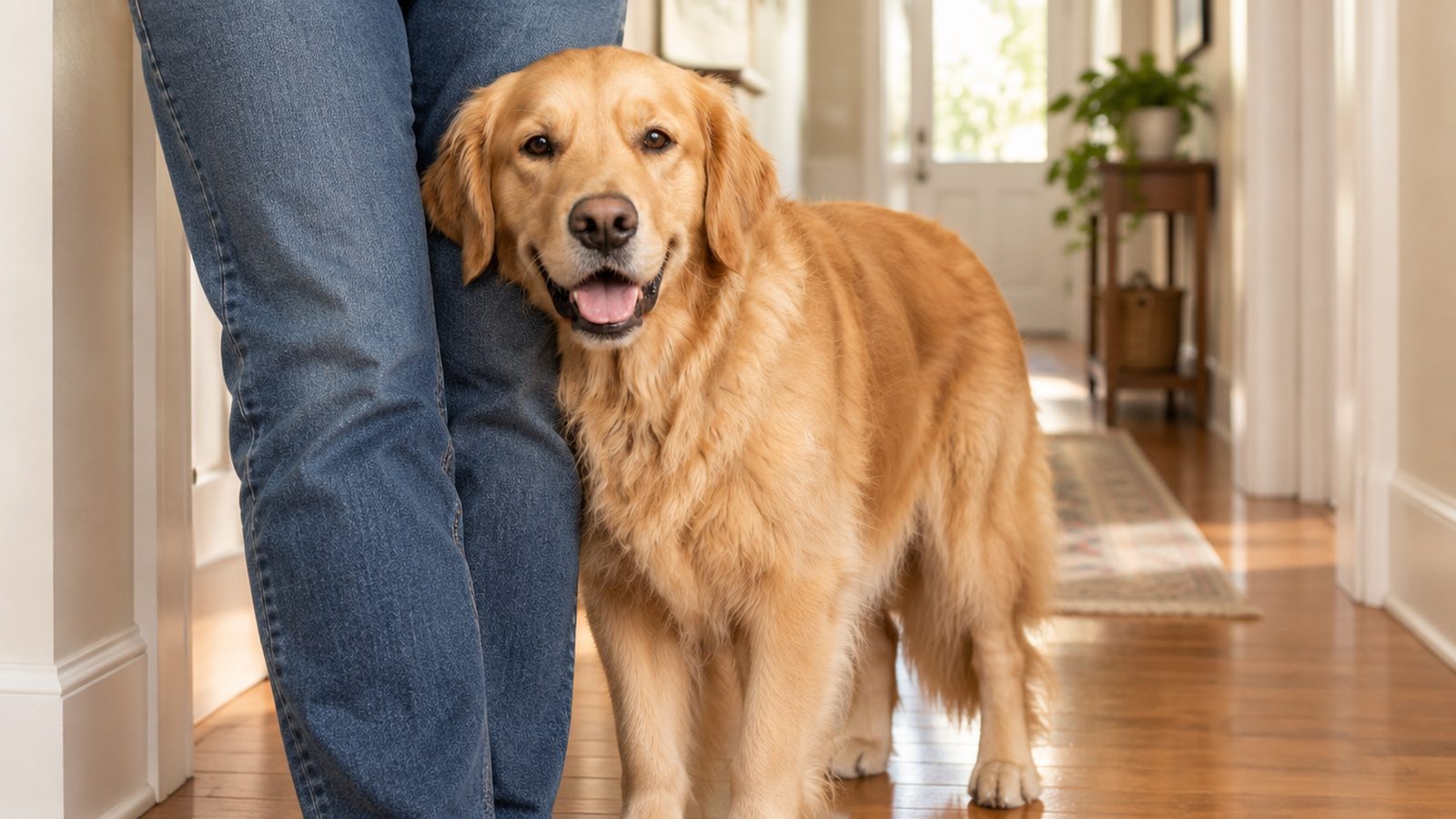
Your dog leans on you for contact and reassurance, because you are its secure base. It is not dominance. If the leaning is new, or your dog seems to be taking weight off a leg, look closer.
The short version
- In a 2013 study, dogs worked on a puzzle significantly longer with their owner in the room. A stranger did not have the same effect.
- Veterinary behavior bodies reject dominance as the explanation for everyday pet behavior like this.
- Context matters: a loose body at home means affection, a tucked tail at the clinic means the dog wants security.
- A newly started lean plus uneven weight on the legs, stiffness or slow rising is a reason to see the veterinarian.
Your dog leans on you to be in contact with the person it feels safest with. It is a way of seeking closeness and reassurance, not an attempt to control you. The one case worth a second look is a dog that has only recently started leaning, or that seems to be taking weight off a leg.
What is a dog getting out of leaning on you?
Contact with you. Researchers describe the dog-owner relationship in the same terms used for young children and caregivers: the owner works as a "secure base" from which the dog deals with the world.
A 2013 study in PLoS One tested this directly. Dogs were given food-filled puzzle toys for five-minute trials under different conditions. In the first experiment, with 20 dogs, they worked on the toys significantly longer when the owner was in the room than when the owner was absent. It did not matter whether the owner encouraged them or sat silent. In the second experiment, with 26 dogs, an unfamiliar person in the room did not produce the same effect. The security was specific to the owner.1
Leaning is that same preference made physical. Dr. Mary Burch, a certified applied animal behaviorist with the American Kennel Club, describes a dog pressing against its person as a way of being close and showing affection, something like a hug. The same article notes that anxious dogs stay close for security.2
Is leaning a sign of dominance?
No.
The American Veterinary Society of Animal Behavior defines dominance narrowly: a relationship between individual animals, established by force or aggression and submission, that decides who gets priority access to resources such as food, resting spots and mates. Its position statement says most unwanted pet behaviors have nothing to do with that. They happen because the behavior was accidentally rewarded.3
Board-certified veterinary behaviorists writing for VCA Animal Hospitals are equally direct. The idea that dogs are in a constant contest for supremacy with their family is, in their words, "incorrect and not supported by scientific study."4
A dog resting its weight on your leg is not taking priority access to anything.
Why does my dog lean more in some situations?
Because leaning usually gets a good result. You reach down, you talk, you stay put. Behaviors that pay off get repeated, which is the same mechanism AVSAB describes for most pet behavior.3 Common patterns:
- At home, body loose, eyes soft: affection and contact.
- At the vet clinic, around strangers, during loud noise: seeking security. Look for a tucked tail, a low body or panting alongside the lean.2
- When you stop petting: a request for more.
If you enjoy it, there is nothing to fix. If the leaning comes with clear fear, tell your veterinarian.
Can leaning be a sign of a sore joint?
Sometimes a change in how a dog carries its weight has a physical cause. We did not find a study that measures leaning on people as a pain sign, so treat this as something to watch, not a conclusion. What veterinary sources do list is closely related.
VCA includes "changes in posture" among five signs of osteoarthritis, giving the examples of changing weight distribution while walking or standing and changing the way a dog sits or lies down.5 Cornell's Riney Canine Health Center lists stiffness, a change in gait, difficulty getting up from lying down, difficulty with stairs or jumping onto a couch, and sudden changes in behavior.6 The Merck Veterinary Manual notes that a lame dog takes a shortened stride on the affected side, and that with a sore front leg the head generally rises as that leg takes weight.7
The useful question is what changed. A dog that has leaned on you since puppyhood is being itself. A dog that started last month deserves a closer look, along with these:
- Does it always lean with the same side?
- When it stands still, is one paw only lightly touching the floor?
- Does it sit with one hind leg kicked out to the side when it used to sit square?
- Is it slower to get up, or hesitating at stairs or the car?
Check tonight
Before dinner, while your dog stands waiting for the bowl, watch its feet for one minute from the side and then from behind. Is the weight even on all four paws? Is one paw barely touching, or does the dog keep shifting from one leg to the other? Then note which side it leans on you with this evening. One evening proves nothing, but the same answer three nights running is worth telling your veterinarian.
When to call your veterinarian
Make an appointment if the leaning is new and comes with any of the signs above, or if your dog is limping, stiff after rest, or reluctant to do things it did easily a few months ago. Say exactly what you saw: "She has started leaning on her left side, keeps her right hind paw light when she stands, and takes longer to get up in the morning. Could you check her joints and watch her walk?" Cornell notes that the earlier osteoarthritis is diagnosed and managed, the better the long-term outcome.6 Veterinarians assess this by watching the dog at rest, rising and walking, and by feeling the bones, joints and muscles.7
Quick answers
Is my dog trying to dominate me by leaning on me?
No. The American Veterinary Society of Animal Behavior defines dominance as priority access to resources won by force, and says most pet behaviors are unrelated to it. Leaning is contact-seeking with a trusted person.
Why does my dog lean on me and not on other people?
Dogs treat their owner as a secure base. In a 2013 PLoS One study, the owner's presence made dogs work longer on a task, while an unfamiliar person did not have the same effect.
Why has my older dog suddenly started leaning on me?
It may simply want more contact, but a new change in how a dog carries its weight can also go with joint discomfort. Watch for uneven weight on the legs, stiffness or slow rising, and describe what you see to your veterinarian.
Sources
- PLoS One (2013). The Importance of the Secure Base Effect for Domestic Dogs - Evidence from a Manipulative Problem-Solving Task (Horn, Huber, Range)
- American Kennel Club (2023). Why Does My Dog Sit on My Feet and Lean on My Legs?
- American Veterinary Society of Animal Behavior (AVSAB) (2008). Position Statement on the Use of Dominance Theory in Behavior Modification of Animals
- VCA Animal Hospitals. Dog Dominance, Alpha, and Pack Leadership - What Does It Really Mean? (Horwitz, Landsberg)
- VCA Animal Hospitals. Five signs your pet has osteoarthritis
- Cornell University, Riney Canine Health Center. Osteoarthritis
- Merck Veterinary Manual, Dog Owners edition (2025). Lameness in Dogs (Harari)
Written by the Tailwise editorial team from the sources above. We are not veterinarians, and this article is not veterinary advice. If something here matches what you see in your dog, talk to your veterinarian.
Better days ahead.