How do you read a dog supplement label?
Look for each active ingredient with its own amount per serving, a separate inactive list, cautions, a lot number and a best-by date. Then check who audits the company, and walk away from any disease claim.
The short version
- Dog supplements are not covered by the US law for human dietary supplements, so label quality varies widely.
- A good label gives the amount of every active ingredient per serving. A proprietary blend gives only a combined weight.
- The NASC Quality Seal belongs to an audited member company, not to a recipe or a factory.
- Claims to treat, cure or prevent a disease are drug claims and are not permitted on supplements.
What rules does a dog supplement label follow?
Start with the legal category, because it explains everything else on the jar. In the US, the 1994 law that governs human dietary supplements (DSHEA) does not cover products for animals. The FDA said so in a 1996 Federal Register notice, and it still says that it does not recognize animal supplements as a special category.12
In practice, a dog supplement sits between two categories the FDA does recognize: animal food and animal drugs. Cornell's Riney Canine Health Center puts the consequence plainly: supplements are not regulated like medications, and a product may not contain what its label states.7
So the label is a promise the company makes. Your job is to check how specific that promise is, and who is checking the company.
What should you find on the label?
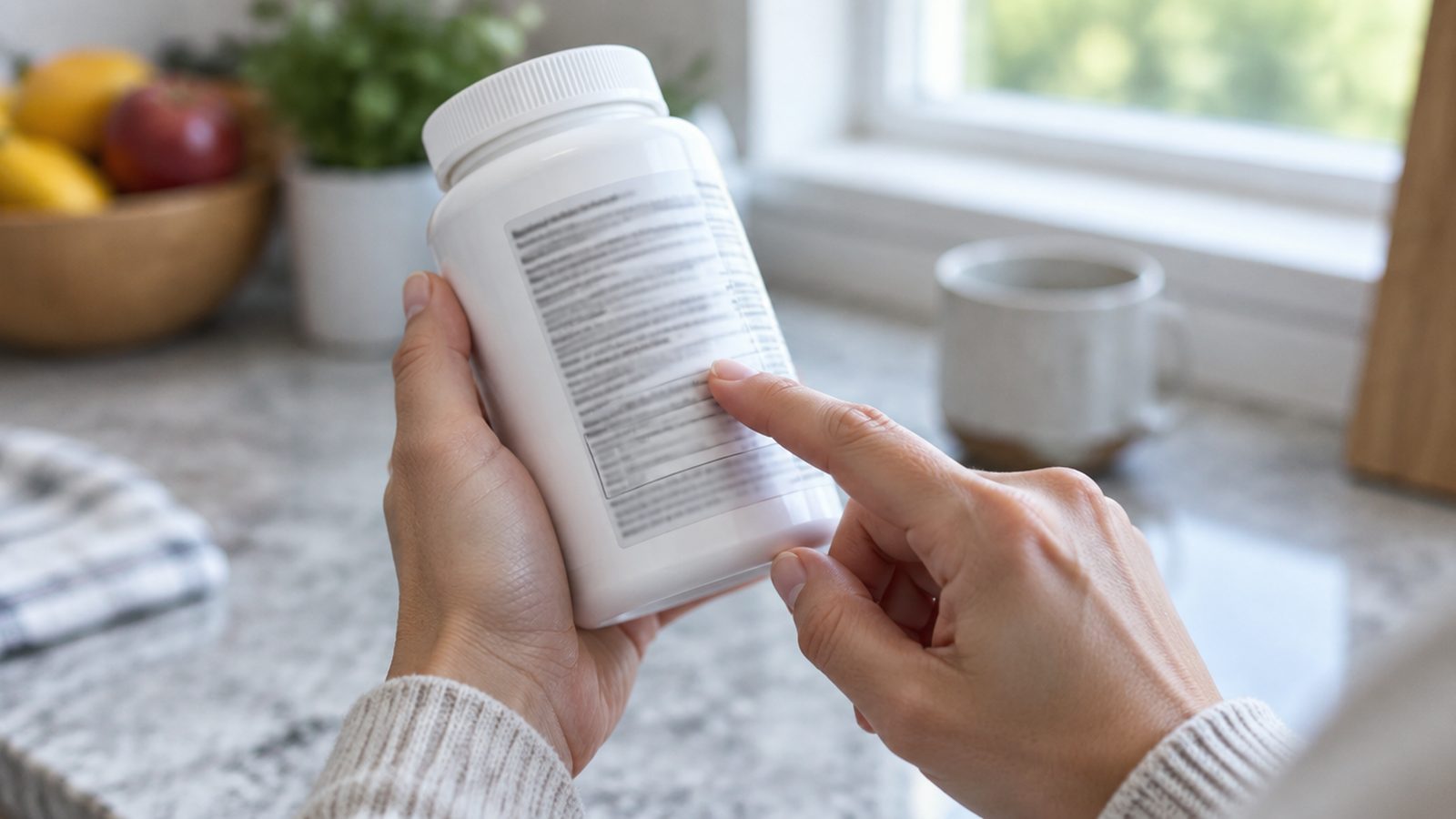
Vermont's Agency of Agriculture worked with the National Animal Supplement Council (NASC) on label guidelines for these products, and its summary is a useful checklist.6 Look for:
- Product name and intended species.
- Active ingredients, listed from largest to smallest amount, with the amount per chew, scoop or tablet.
- Inactive ingredients, listed separately. These are the base, flavor and binders.
- Directions for use.
- Net weight or count.
- Manufacturer or distributor name and contact details.
Add four things we think any careful buyer should also expect: caution statements, an allergen note where relevant, a lot number and a best-by date. NASC requires its members to print the caution statements that the FDA's Center for Veterinary Medicine recommends for particular ingredients.4 The lot number is what lets a company trace one batch if something goes wrong.
What does "proprietary blend" hide?
The amounts. A blend lists its ingredients under one combined weight, so you cannot tell how much of each is in a serving. The label format above allows this: per-serving amounts are expected unless a proprietary blend is used.6
That matters when you want to compare a product with the amounts used in published studies, or when your veterinarian asks what your dog is getting. A label that states each active with its own amount can be checked. A blend cannot.
Check tonight
Pick up any supplement or treat jar you already own and time yourself for two minutes. Find five things: the amount of each active ingredient per serving, the inactive ingredient list, a caution statement, the lot number and the best-by date. Count how many you found. Anything missing is a fair question to email the brand.
What do the NASC Quality Seal and cGMP mean?
The NASC Quality Seal belongs to a company, not to an ingredient or a recipe. To display it, a NASC member company must pass an independent quality audit and meet a set of ongoing requirements:4
- written standard operating procedures for production;
- an adverse event reporting and complaint system;
- compliance with NASC labeling guidelines on all labels and marketing;
- random product testing by an independent lab to confirm the product meets its label claim.
Cornell suggests looking for the seal for this reason.7 A product made in an audited facility but sold by a brand that is not a member cannot carry it.
cGMP stands for current good manufacturing practice. The FDA describes it, for drugs, as systems that assure proper design, monitoring and control of manufacturing processes and facilities. The "c" means the methods must be up to date.3 On a supplement, ask who certified the facility and when.
A Certificate of Analysis (COA) is the lab report for one lot. You can ask a brand for the COA that matches the lot number on your jar, whether an outside lab did the testing, and what was tested: the amount of each active, heavy metals and microbes.
Which words on a label are red flags?
Any claim to treat, cure, prevent or mitigate a disease. Under federal law, that intent makes a product a drug, and the FDA says such claims require approval through the new animal drug process.15 A supplement that says it "treats arthritis" or "cures hip dysplasia" is making a claim it is not allowed to make.
Other warning signs: no amounts, no lot number, no way to contact the company, and promises of results by a fixed date.
When to call your veterinarian
Call before starting any supplement if your dog takes prescription medication, has a diagnosed condition, is pregnant or is still growing. Bring the jar or a photo of the full label and ask: "Is anything on this list a problem with my dog's medications or conditions?" Stop the product and call if you see vomiting, diarrhea, itching or loss of appetite after starting it.
How our own label measures up
Tailwise Hip & Joint lists each active with its amount per chew and uses no proprietary blend: green lipped mussel 200 mg, Boswellia serrata 25 mg, turmeric 25 mg, Yucca schidigera 25 mg and black pepper 5 mg. It is made in the USA in a facility that holds a NASC audit certificate and a third-party cGMP certificate. Tailwise itself is not a NASC member company, so the jar does not carry the NASC Quality Seal. The lot number and best-by date are printed on the bottom of the jar. It contains shellfish.
Quick answers
Are dog supplements regulated by the FDA?
Not as dietary supplements. The FDA says the human supplement law (DSHEA) does not apply to animal products and does not recognize animal supplements as a special category. A product that claims to treat or prevent disease is a drug under federal law.
What does the NASC Quality Seal mean on a dog supplement?
It means the company is a National Animal Supplement Council member that passed an independent quality audit, runs an adverse event reporting system, follows NASC labeling guidelines and submits to random independent product testing.
What is a proprietary blend in a dog supplement?
A group of ingredients listed under one combined weight. You can see what is in it but not how much of each ingredient your dog gets per serving.
Sources
- U.S. Food and Drug Administration, Center for Veterinary Medicine. FDA's Regulation of Pet Food
- Federal Register, Vol. 61, No. 78 (FDA) (1996). Inapplicability of the Dietary Supplement Health and Education Act to Animal Products (Docket No. 95N-0308)
- U.S. Food and Drug Administration. Facts About the Current Good Manufacturing Practice (CGMP)
- National Animal Supplement Council. NASC Quality Seal
- U.S. Food and Drug Administration, Center for Veterinary Medicine. Animal Food Labeling and Pet Food Claims
- Vermont Agency of Agriculture, Food and Markets (2022). Dosage Form Animal Health Product or Feed Supplement?
- Cornell University College of Veterinary Medicine, Riney Canine Health Center. How joint supplements can help with orthopedic conditions
Written by the Tailwise editorial team from the sources above. We are not veterinarians, and this article is not veterinary advice. If something here matches what you see in your dog, talk to your veterinarian.
More years. Better years.