Do Boswellia, turmeric and yucca help a dog's joints?
Possibly, but the evidence in dogs is thin. Boswellia rests on one uncontrolled study, turmeric trials conflict, and yucca has no controlled joint trial that we could find. Omega-3 sources have more and better dog data.
The short version
- The main Boswellia dog study (2004) followed 24 dogs for six weeks and reported fewer signs, but it had no placebo group and was not blinded.
- Two placebo-controlled turmeric trials in dogs with osteoarthritis found no difference on force plate testing; some subjective scores improved.
- The 2,000% black pepper figure for curcumin absorption comes from human volunteers, not dogs.
- Boswellia and turmeric may affect bleeding risk, especially alongside NSAIDs. Ask your veterinarian first.
Possibly, but the dog evidence for all three is limited. Boswellia has one uncontrolled dog study, turmeric trials have given conflicting results, and we found no controlled dog joint trial of yucca on its own. A 2022 meta-analysis found clear evidence only for omega-3 sources.1
What are Boswellia, turmeric and yucca?
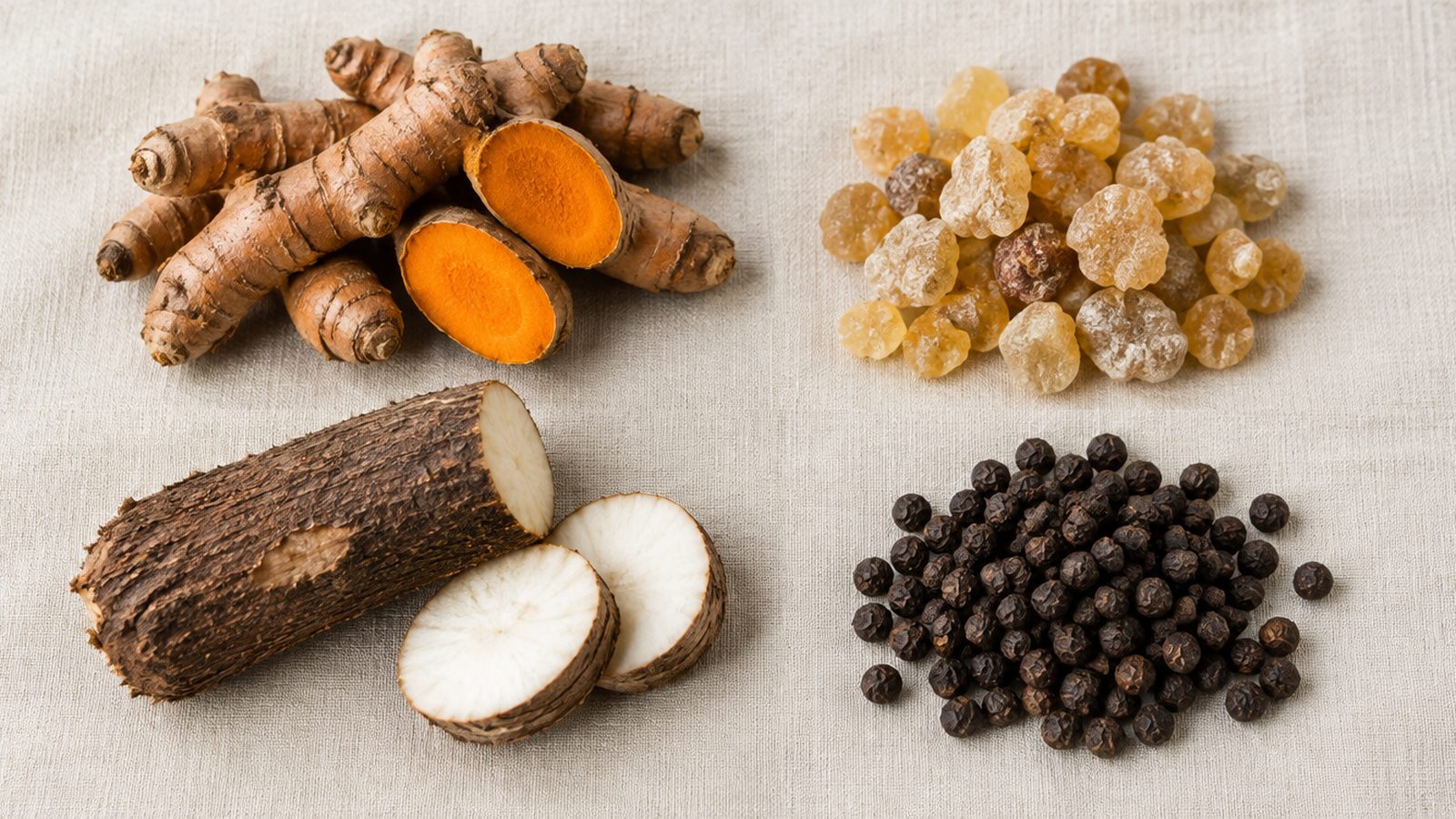
- Boswellia serrata is a tree. Supplements use an extract of its resin.2
- Turmeric is the spice plant Curcuma longa.7 Curcumin is the compound in it that most research focuses on.5
- Yucca schidigera is a plant whose extract contains saponins and is added to some dog and cat diets.6
What did the dog study on Boswellia measure?
The study most often cited is Reichling and colleagues, 2004, an open, multi-center trial: 29 dogs with chronic joint or spinal disease were enrolled, 24 were included in the analysis, and all of them received a Boswellia resin extract with their food for six weeks.2
The authors reported an overall effect in 71% of the 24 dogs after two weeks, and a statistically significant reduction in signs such as intermittent lameness, local pain and stiff gait after six weeks. Five dogs had brief diarrhea or flatulence; a link to the extract was suspected in one.2
The limit is the design. There was no placebo group, and everyone knew what the dogs were getting, so the result cannot separate the extract from expectation. Boswellia also appears in tested multi-ingredient products, where its own contribution cannot be isolated.1
What did the dog studies on turmeric find, and why is black pepper added?
Turmeric has controlled trials, and they disagree.
- Innes and colleagues, 2003. A randomized, double-blind, placebo-controlled trial of a turmeric extract (P54FP) in dogs with osteoarthritis, over eight weeks. Force plate measurements showed no statistical difference between groups, and neither did owner assessments. The investigators' assessment favored the extract.3
- Comblain and colleagues, 2017. A three-month randomized, double-blind, placebo-controlled trial completed by 42 dogs with osteoarthritis. The test diet combined curcuminoid extract, hydrolyzed collagen and green tea extract. Force plate analysis again showed no difference. Pain on manipulation and ability to rise from lying down improved in the supplemented group.4
In both, the objective gait measure did not move and some subjective ones did. The second tested three ingredients together. The 2022 meta-analysis described turmeric results as conflicting.1
One likely reason is absorption. A review of curcumin research describes its bioavailability as poor, mainly because of poor absorption, rapid metabolism and rapid elimination.5 That is why turmeric is often paired with black pepper. Its main active compound, piperine, increased curcumin bioavailability by 2,000% in a 1998 study by Shoba and colleagues.5 That figure comes from human volunteers; the same paper also tested rats. We have not found a study showing the effect in dogs.
Is there evidence for yucca in dog joints?
Very little. The pet research on Yucca schidigera that we could find looks at digestion, not joints. A 1997 study added yucca extract to dog and cat diets and measured stool odor, stool pH, food transit time and blood values.6 The 2022 meta-analysis of 72 trials does not describe a yucca trial.1 Its place in joint formulas rests on traditional use, not on trials in dogs with joint problems.
How do these botanicals compare with omega-3 sources, and are they safe?
The 2022 meta-analysis by Barbeau-Grégoire and colleagues pooled 72 trials in nine categories. It reported "evident clinical analgesic efficacy" for omega-3-enriched diets and omega-3 supplements, a group that included green lipped mussel, and it did not find enough evidence to recommend the botanical and mixed-ingredient categories.1
| Ingredient | Dog evidence we could verify | Main limit |
|---|---|---|
| Boswellia serrata | One open study, 24 dogs analyzed, 6 weeks | No placebo group, not blinded |
| Turmeric / curcumin | Two placebo-controlled trials | No change on force plate; mixed subjective results |
| Yucca schidigera | Diet studies on digestion | No controlled joint trial found |
| Omega-3 sources | 20 trials in the 2022 meta-analysis | Products vary between trials |
The Merck Veterinary Manual lists Boswellia as typically well tolerated with occasional stomach upset, and notes it may inhibit platelet aggregation and so increase bleeding risk. For turmeric it lists diarrhea, flatulence or bloating at high doses, and a possible increase in bleeding risk when combined with NSAIDs.7
When to call your veterinarian
Talk to your veterinarian before giving Boswellia or turmeric if your dog takes an NSAID, a blood thinner or any daily medication, or has surgery scheduled. Say: "My dog is on [medication]. This chew contains Boswellia and turmeric. Is that a problem?" Call promptly for vomiting, diarrhea, unusual bruising or bleeding, or lameness that is new or worsening.
Check tonight
After your dog has been lying down for at least 20 minutes, call them and watch the first ten steps. Count the seconds it takes to stand, and note any stiffness that eases as they walk. Save the number with the date. Repeat weekly and bring the record to your next vet visit.
Why they are in Tailwise
Tailwise Hip & Joint is built around New Zealand green lipped mussel (200 mg per chew) and includes Boswellia serrata 25 mg, turmeric 25 mg, Yucca schidigera 25 mg and black pepper 5 mg per chew. Each amount is listed individually, with no proprietary blend. The studies described above used other products and other amounts, so their results are not results for ours. The chew supports joint comfort and mobility. It contains shellfish.
Quick answers
Is turmeric good for dogs with arthritis?
The evidence is mixed. Two placebo-controlled trials in dogs with osteoarthritis found no difference on force plate testing, while some veterinarian or owner scores improved, and a 2022 meta-analysis called turmeric results conflicting. Ask your veterinarian before adding it, especially alongside an NSAID.
Does black pepper help dogs absorb turmeric?
It is unproven in dogs. The widely quoted 2,000% increase in curcumin bioavailability with piperine comes from a 1998 study in human volunteers, and we have not found a study showing the same effect in dogs.
Can I give my dog Boswellia with an NSAID?
Ask your veterinarian first. The Merck Veterinary Manual notes that Boswellia may inhibit platelet aggregation and that turmeric may increase bleeding risk when combined with NSAIDs.
Sources
- International Journal of Molecular Sciences (MDPI) (2022). A 2022 Systematic Review and Meta-Analysis of Enriched Therapeutic Diets and Nutraceuticals in Canine and Feline Osteoarthritis (Barbeau-Grégoire et al.)
- Schweizer Archiv für Tierheilkunde (abstract via ResearchGate) (2004). Dietary support with Boswellia resin in canine inflammatory joint and spinal disease (Reichling et al.)
- Veterinary Practice News. A closer look at OA supplements, Part 2 (summary of Innes et al. 2003, Veterinary Record, P54FP trial)
- BMC Veterinary Research (2017). A randomized, double-blind, prospective, placebo-controlled study of the efficacy of a diet supplemented with curcuminoids extract, hydrolyzed collagen and green tea extract in owner's dogs with osteoarthritis (Comblain et al.)
- Foods (via PubMed Central) (2017). Curcumin: A Review of Its Effects on Human Health (Hewlings & Kalman)
- Research in Veterinary Science (1997). The ameliorating effect of Yucca schidigera extract on canine and feline faecal aroma (Lowe & Kershaw)
- Merck Veterinary Manual. Table: Common Botanical Products in Veterinary Medicine
Written by the Tailwise editorial team from the sources above. We are not veterinarians, and this article is not veterinary advice. If something here matches what you see in your dog, talk to your veterinarian.
More years. Better years.