
Poodle joints, weight and aging: what to watch and when
It depends on size. Toy and Miniature Poodles are prone to kneecap and early hip problems and dental disease. Standards are prone to hip dysplasia, bloat and Addison's disease.
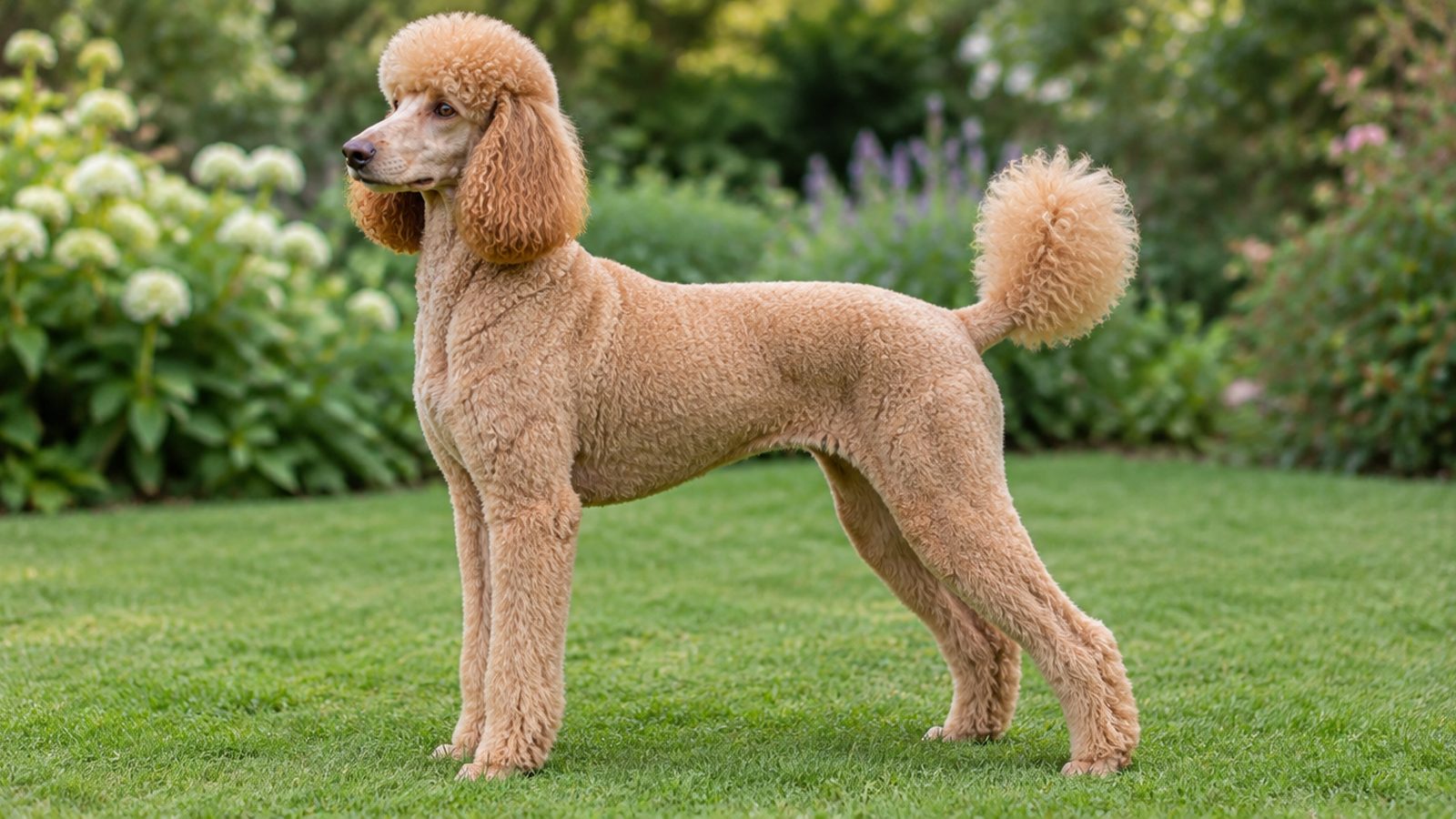
Poodle at a glance
- Size
- Miniature 10–15 lb, 10–15 in; Standard 40–70 lb, over 15 in; Toy 4–6 lb, up to 10 in1
- Typical lifespan
- about 14 years (UK median 14.0, all sizes combined)2
- Senior from
- about 10–11 years
- Main joint risks
- Toy/Miniature: patellar luxation, Legg-Calvé-Perthes; Standard: hip dysplasia1
- Also watch
- Standard: bloat, Addison's disease; Toy: dental disease1
The short version
- Toy and Miniature: patellar luxation, Legg-Calvé-Perthes disease (4–11 months) and dental disease.
- Standard: hip dysplasia, bloat, Addison's disease and sebaceous adenitis.
- UK median lifespan is 14.0 years for Poodles of all sizes combined; senior from about 10–11.
- Toy Poodles had 3.97 times the dental disease risk in a UK study of 22,333 dogs.
What a Poodle owner should watch depends on the size. In Toy and Miniature Poodles it is the knees, the hips in the first year, and the teeth. In Standard Poodles it is the hips, bloat and Addison's disease.
What is a Poodle built for?
The Poodle began as a duck-hunting water retriever in Germany more than 400 years ago. The Standard was later bred down to the Miniature, and the Toy was first bred in America in the early 20th century as a city companion.1 All three are bred to one standard and differ only in size.1
The American Kennel Club describes the Standard as over 15 inches tall and 40–70 pounds, the Miniature as 10–15 inches and 10–15 pounds, and the Toy as no more than 10 inches and 4–6 pounds.1 That is a tenfold spread in weight, so the body's weak points differ. Small, light legs tend toward kneecap problems. The larger frame tends toward the hip and stomach problems of bigger dogs.
Which joint problems are Poodles prone to?
AKC states that Legg-Calvé-Perthes disease and luxating patellas are more likely in Toy and Miniature Poodles than in Standards, and lists hip dysplasia among the breed's health issues.1
| Condition | Which size | What it is | When it tends to show |
|---|---|---|---|
| Patellar luxation | Toy, Miniature | The kneecap rides outside its groove when the knee bends. Dogs often skip for a few steps, then walk normally4 | Mostly developmental and found in young dogs4 |
| Legg-Calvé-Perthes disease | Toy, Miniature | Blood supply to the ball of the hip is disrupted and the bone weakens, causing a painful hind-leg limp5 | Most often 4–11 months of age5 |
| Hip dysplasia | Mainly Standard | A hip joint that does not fit well. The breed club lists a hip evaluation for Standards and Miniatures1 | We found no Poodle-specific age figure |
The American College of Veterinary Surgeons names Miniature Poodles among the small breeds predisposed to patellar luxation, and says it affects both knees in about half of cases.4 Cornell lists Toy and Miniature Poodles among the breeds most often affected by Legg-Calvé-Perthes disease.5 We could not read OFA's breed percentages for this article. When you see them, remember they come from dogs whose owners submitted X-rays, not a random sample.
How long do Poodles live, and when is one a senior?
A UK analysis of 6,427 Poodles found a median life expectancy of 14.0 years.2 That dataset does not separate the three sizes. AKC states 10–18 years for each variety.1 We did not find a large dataset that gives lifespan by size, and UK dogs may differ from US dogs.
AAHA defines senior as the last 25% of estimated lifespan.3 By our arithmetic on the UK median, that starts at about 10.5 years. Ask your veterinarian whether your Standard should start senior checks a little earlier.
What else should a Poodle owner watch?
- Bloat and skin (Standard). AKC says the Standard is more at risk for gastric dilatation with volvulus (bloat) and for sebaceous adenitis, an inflammatory skin condition.1
- Addison's disease (Standard). The Merck Veterinary Manual lists the Standard Poodle among overrepresented breeds. It usually starts in young to middle-aged adults, and females are affected more often. Signs are vague and come and go: poor appetite, weight loss, vomiting, diarrhea, low energy.6
- Teeth (Toy). In a UK study of 22,333 dogs, 12.5% had dental disease recorded in a year. Toy Poodles had 3.97 times the risk, and dogs under 10 kg (22 pounds) had about three times the risk of dogs weighing 30–40 kg.7
What can you do at home?
Watch weight. AKC notes that some Poodles are prone to getting overweight and that too many treats can cause obesity.1 Extra weight is extra load on small knees and on large hips alike.
Poodles of every size are active dogs that need good exercise every day. AKC suggests swimming, retrieving games and long walks.1 For the vet, note which leg skips, how often, and whether it is getting more frequent.
Check tonight
For a Toy or Miniature: watch your dog trot away from you for one minute and count how many times a back leg is carried for a few steps before it goes down again. For a Standard: watch him get up after a long rest and note any stiffness in the back end. Then, for any size, lift the lip and look at the back teeth and gum line for one minute. Write down what you see.
What should you ask your veterinarian?
When to call your veterinarian
- Standard, now: retching with nothing coming up, a swelling belly, or sudden weakness or collapse.
- Standard, this week: vomiting, poor appetite and low energy that keep coming back.
- Toy or Miniature, this week: a puppy under a year with a hind-leg limp that is getting worse, or a skip that is becoming more frequent.
- "Is my dog at a lean body condition for his size?"
- "Can you check the kneecaps and hips today?" The breed club lists a patella evaluation for Toys and Miniatures and a hip evaluation for Miniatures and Standards.1
- "Which other screens apply?" All three sizes have an eye exam listed. Toys and Miniatures also have a DNA test for progressive retinal atrophy. Standards have thyroid and von Willebrand tests.1
- "How often should the teeth be checked and cleaned?"
Quick answers
What health problems are Poodles prone to?
It depends on size. Toy and Miniature Poodles are more prone to patellar luxation and Legg-Calvé-Perthes disease, and Toy Poodles to dental disease. Standard Poodles are more at risk for bloat, sebaceous adenitis and Addison's disease.
How long do Poodles live?
A UK analysis of 6,427 Poodles found a median life expectancy of 14.0 years, with all sizes combined. The American Kennel Club states 10–18 years for each variety.
Why does my Toy Poodle skip on a back leg?
A skip for a few steps is the typical sign of patellar luxation, where the kneecap slips out of its groove. Miniature Poodles are among the breeds the American College of Veterinary Surgeons names as predisposed. Ask your veterinarian to check the kneecaps.
Sources
- American Kennel Club. Poodle (Miniature) Dog Breed Information; Standard and Toy pages used for their sizes
- Dogs Trust (2024). Life expectancy for 155 breeds and crossbred group (breed table for McMillan et al., Longevity of companion dog breeds, Scientific Reports)
- American Animal Hospital Association (2019). Canine Life Stage Definitions (2019 AAHA Canine Life Stage Guidelines)
- American College of Veterinary Surgeons. Patellar Luxations
- Cornell University College of Veterinary Medicine, Riney Canine Health Center. Avascular necrosis of the femoral head (Legg-Calvé-Perthes Disease) in dogs
- Merck Veterinary Manual. Addison Disease (Hypoadrenocorticism) in Animals
- Royal Veterinary College VetCompass (2021). New RVC research gets to the root of dental disease in dogs (O'Neill et al. 2021, Journal of Small Animal Practice)
Written by the Tailwise editorial team from the sources above. We are not veterinarians, and this article is not veterinary advice. If something here matches what you see in your dog, talk to your veterinarian.
More years. Better years.