Australian Shepherd joints, weight and aging: what to watch and when
Watch the hips and elbows, find out your dog's MDR1 status, and keep up with eye exams. About half of Australian Shepherds carry the MDR1 mutation, and the breed typically lives 12 to 15 years.
Australian Shepherd at a glance
The short version
- Hip dysplasia was found in 11–13% of Australian Shepherds X-rayed in a French screening program; elbow dysplasia was reported in 4–9% of dogs in a US breed survey.
- About 50% of Australian Shepherds carry the MDR1 mutation, which can cause severe reactions to some common drugs. Only a test tells you your dog's status.
- The AKC gives a lifespan of 12 to 15 years; by the AAHA rule that makes an Aussie a senior from about 9 to 11.
- The breed club's required screenings are hips, elbows and eyes.
An Australian Shepherd owner should watch the hips and elbows, know the dog's MDR1 drug-sensitivity status, and keep up with eye exams. The breed is long-lived and very active, so the aim is to keep a working body sound for 12 years or more.
What is an Australian Shepherd built for?
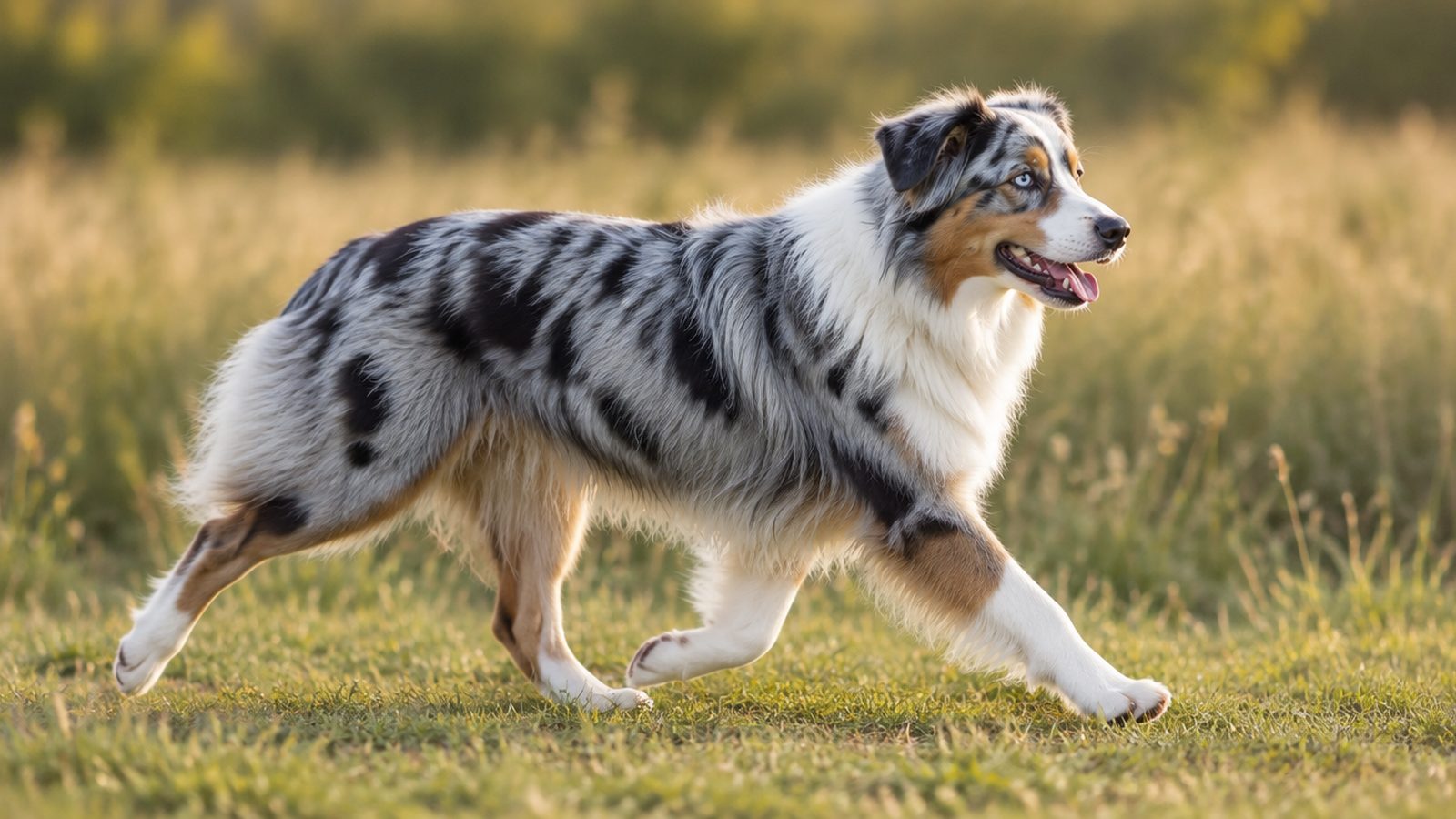
The AKC standard describes "an intelligent working dog of strong herding and guarding instincts."1 Despite the name, the breed was developed in the American West to work sheep.2 The preferred height is 20 to 23 inches for males and 18 to 21 inches for females,1 and adults tend to weigh 40 to 65 pounds.3
It is a medium, athletic frame made for long days of running, turning and stopping. That work loads the hips, elbows and knees.
Which joint and mobility problems are Australian Shepherds prone to?
| Condition | What it is | What the evidence says for this breed |
|---|---|---|
| Hip dysplasia | The bones of the hip joint are not properly formed, causing pain and lameness from mild to severe6 | 11–13% of Aussies X-rayed in a French screening program;4 reported in 10% or more of dogs in a US breed health survey5 |
| Elbow dysplasia | A similar malformation of the elbow joint6 | Reported in 4–9% of dogs in the breed survey5 |
| Cruciate ligament rupture | A tear of the main stabilizing ligament in the knee | Reported in 2–3% of dogs in the breed survey5 |
Both data sets need a caution. The French figures cover dogs whose owners and breeders submitted X-rays between 1997 and 2017, which is not a random sample, and the rate did not change significantly over that time.4 The US figures come from the Australian Shepherd Health & Genetics Institute's 2009–2010 owner survey, which reports ranges, not exact percentages.5
The sources we checked give no reliable breed-specific age at which these problems appear. Hip and elbow dysplasia are developmental, so the joint forms abnormally during growth even when lameness comes later.
How long do Australian Shepherds live, and when is one a senior?
The AKC gives a typical lifespan of 12 to 15 years.3 That is a stated range, not a figure from a large mortality dataset.
The American Animal Hospital Association defines the senior stage as the last 25% of estimated lifespan.7 Our arithmetic: 75% of 12 to 15 years is 9 to about 11 years. Ask your veterinarian about a senior check from age 9.
What else should an Australian Shepherd owner watch?
- MDR1 drug sensitivity. Washington State University's veterinary lab puts the frequency of the MDR1 mutation in Australian Shepherds at about 50%. Dogs with it "may have severe and life-threatening reactions to some common drugs," and the only way to know an individual dog's status is to test.8 This matters for anything your dog is given. Tell every veterinarian and ask about testing.
- Hereditary eye disease. The breed club lists hereditary cataracts, collie eye anomaly and several other eye conditions, and requires an eye exam for health certification.6 Cataracts were reported in 4–9% of dogs in the breed survey and collie eye anomaly in about 1%.5
- Epilepsy. Reported in 4–9% of dogs in the same survey.5
What can you do at home?
Keep him lean. Weight is the best-supported lever an owner has for joints. In a lifetime study of 48 Labrador Retrievers, dogs fed 25% less lived a median 13.0 years against 11.2, with osteoarthritis starting later.9 That study was in Labradors, not Aussies.
Exercise for the build. General guidance, not a study result: this breed needs daily work for body and mind,3 and steady, varied activity is easier on joints than long sessions of repeated hard jumping and sharp turns.
Keep a record. Note the date of any limp, any seizure-like episode, and any reaction after a medication.
Check tonight
On a flat surface, have someone lead your Aussie at a trot straight toward you, then straight away, for about a minute. From the front, watch the head: does it bob up and down with one front leg? From behind, watch whether the hips rise evenly and both back legs take the same length of stride. Note what you see and which side.
What should you ask your veterinarian?
When to call your veterinarian
- Go now: a seizure that does not stop, or any sudden change in your dog after a medication or parasite product. Say that your dog is an Australian Shepherd and give his MDR1 status if you know it.8
- Call the same day: a first seizure, or a leg he will not bear weight on.
- Book a visit: a limp or stiffness after rest that lasts more than a few days, or cloudiness in an eye.
Questions to bring:
- "Has he been tested for MDR1? If not, can we test, and can you note the result on his record?"
- "Should we X-ray hips and elbows?" The breed club's required screenings are hip and elbow evaluations and an eye exam; collie eye anomaly and MDR1 tests are optional extras.6
- "How often should his eyes be examined?"
- "Is he at a lean weight for the amount of work he does?"
Quick answers
What is MDR1 in Australian Shepherds?
MDR1 is a gene mutation that can cause severe, life-threatening reactions to some common drugs. Washington State University puts its frequency in Australian Shepherds at about 50%, and testing is the only way to know an individual dog's status.
How long do Australian Shepherds live?
The AKC gives a typical lifespan of 12 to 15 years for the breed.
Are Australian Shepherds prone to hip dysplasia?
It is one of the breed's more common problems. In a French screening program 11–13% of Australian Shepherds X-rayed were graded dysplastic, and a US breed health survey reported it in 10% or more of dogs. Neither is a random sample.
Sources
- American Kennel Club. Official Standard of the Australian Shepherd
- American Kennel Club. Australian Shepherd History: Behind the Breed's Herding Heritage
- American Kennel Club. Is the Australian Shepherd the Right Dog Breed for You?
- PLOS ONE (Baldinger et al.) (2020). Prevalence of canine hip dysplasia in 10 breeds in France, a retrospective study of the 1997-2017 radiographic screening period
- Australian Shepherd Health & Genetics Institute (2013). Disease Prevalence in Aussies
- United States Australian Shepherd Association. USASA Health & Genetics Program
- American Animal Hospital Association (2019). Canine Life Stage Definitions (2019 AAHA Canine Life Stage Guidelines)
- Washington State University College of Veterinary Medicine (2021). Dog breeds commonly affected by MDR1 mutation
- British Journal of Nutrition (Lawler et al.) (2008). Diet restriction and ageing in the dog: major observations over two decades
Written by the Tailwise editorial team from the sources above. We are not veterinarians, and this article is not veterinary advice. If something here matches what you see in your dog, talk to your veterinarian.
More years. Better years.