Boxer joints, spine and aging: what to watch and when
Watch the hips, the spinal cord and the spine, then lumps and the heart. Boxers reach the senior stage at about 8 to 8.5 years.
Boxer at a glance
The short version
- Of 7,731 Boxer hip evaluations in the OFA database, 12.7% were rated dysplastic.
- 49.4% of DNA-tested Boxers carry two copies of the degenerative myelopathy risk variant; not all of them develop the disease.
- UK median life expectancy is 11.3 years, which puts the senior stage at about 8 to 8.5 years.
- Any new lump, and any fainting or collapse, is a reason to call your veterinarian.
Boxer owners should watch the back half of the dog first (hips, spinal cord and spine), and then lumps and the heart.
What is a Boxer built for?
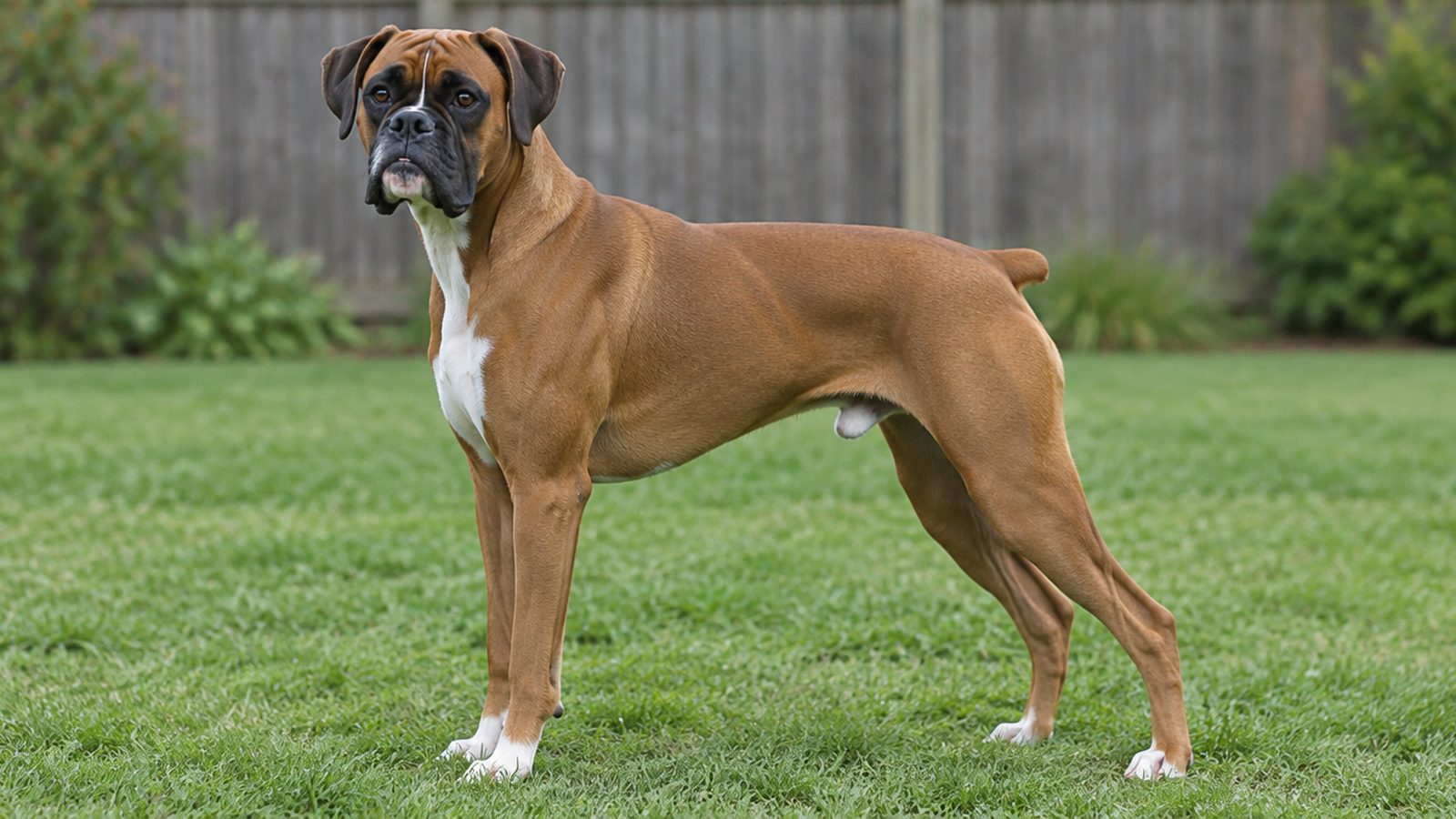
The AKC breed standard says the Boxer was "developed to serve as guard, working, and companion dog." It describes a medium-sized, square-built dog with a short back. Males stand 23 to 25 inches at the withers and females 21.5 to 23.5 inches.1 It gives no weight. In a UK study of 3,219 Boxers in veterinary care, adult males averaged 33.0 kg (about 73 lb) and females 27.6 kg (about 61 lb).5
That is a lot of muscle on a compact, deep-chested frame.1 Boxers sprint, jump and turn hard, and the hind legs do most of the pushing. The conditions with the best evidence in this breed sit in the hips and along the spine.
Which joint and mobility problems are Boxers prone to?
Three have breed-specific evidence. Orthopedic Foundation for Animals (OFA) figures come from dogs whose owners chose to submit X-rays or DNA results, so they are not a random sample of pet Boxers.
| Condition | What it is | When it tends to show |
|---|---|---|
| Hip dysplasia | The hip joint forms loosely and wears toward arthritis | From the growing months, or only later in life |
| Degenerative myelopathy | Inherited disease of the spinal cord; painless hind-leg weakness | Usually after age 84 |
| Spondylosis deformans | Bony growths along the underside of the vertebrae | Builds with age; usually causes no signs4 |
Hip dysplasia. Of 7,731 Boxer hip evaluations in the OFA database, 12.7% were rated dysplastic and 85.7% normal.2
Degenerative myelopathy (DM). The Merck Veterinary Manual names Boxers among the affected breeds. Dogs are usually older than 8 and slowly develop nonpainful weakness and incoordination in the hind legs.4 Of 6,175 Boxers DNA-tested through OFA, 49.4% carried two copies of the SOD1 risk variant and 29.6% carried one.2 Two copies means "at risk," not "will get it." The UC Davis genetics laboratory states that not all dogs with two copies develop signs.8
Spondylosis deformans. Merck describes it as notably common in Boxers. Across all dogs it affects 25 to 70% by age 9. It does not typically cause signs, though back pain is possible in rare cases.4
Elbows look low-risk: 1.1% of 1,795 Boxer elbow evaluations were abnormal.2 Cruciate ligament disease is sometimes listed for Boxers, but the breed-specific evidence we found is thin, so we leave it out.
How long do Boxers live, and when is one a senior?
A 2024 study of UK dogs put the Boxer's median life expectancy at 11.3 years, against 12.5 years for all dogs.6 The UK veterinary-records study found a median age at death of 10.46 years across 346 Boxers.5 Both are UK datasets, and US dogs may differ.
AAHA defines the senior stage as the last 25% of estimated lifespan.7 Our arithmetic: 75% of 10.5 to 11.3 years puts the start of the senior stage at about 8 to 8.5 years.
What else should a Boxer owner watch?
- Lumps and cancers. In the UK study, neoplasia was recorded in 14.2% of Boxers within a single year, and a skin mass in 4.3%. Neoplasia was the most common recorded cause of death (12.4%), followed by brain disorders (9.5%).5
- Heart. A heart murmur was recorded in 4.3% of Boxers.5 The OFA screening list for the breed includes an advanced cardiac exam with a 24-hour Holter monitor and a DNA test for arrhythmogenic right ventricular cardiomyopathy (ARVC), a heart rhythm disorder.2
What can you do at home?
Keep your Boxer lean. Weight is the best-supported lever an owner controls. In a lifetime study of 48 Labrador Retrievers, dogs fed 25% less than their paired littermates lived a median 13.0 years against 11.2, with later onset of late-life diseases, especially osteoarthritis.3 Those were Labradors, not Boxers, but it is the strongest long-term evidence we know of.
Exercise for the build. General guidance, not a Boxer study: steady daily movement on footing with grip suits a heavy, athletic dog better than a quiet week followed by an all-out weekend.
Check tonight
On a hard floor or sidewalk, walk your Boxer 20 steps away from you and back. Listen for nails scraping and watch the back feet. Do they land flat on the pads each time, or does a foot drag or turn under? Dogs with DM have difficulty sensing and placing their feet.4 Note what you see and the date. This is an observation, not a diagnosis.
What should you ask your veterinarian?
When to call your veterinarian
- Fainting or collapse, especially with exercise or excitement: call right away.
- Back feet dragging or knuckling, a wobbly hind end, or a sudden refusal to put weight on a leg: same day.
- Any new lump, or a lump that grows or changes: book a visit this week.
Questions worth bringing:
- Should my Boxer have a cardiac exam with a Holter monitor, and how often?
- Which of these lumps should be sampled?
- What is my dog's body condition score, and what weight should we aim for?
The screening tests OFA lists for the breed with the parent club are a hip evaluation (OFA or PennHIP), an autoimmune thyroiditis evaluation, an advanced cardiac exam including a Holter monitor, and DNA tests for DM and ARVC.2 They are designed for breeding dogs, but you can ask whether your dog's parents had them.
Quick answers
Do Boxers get hip dysplasia?
Some do. Of 7,731 Boxer hip evaluations in the OFA database, 12.7% were rated dysplastic. Those dogs were submitted by their owners, so the figure is not a random sample of pet Boxers.
At what age is a Boxer considered a senior?
At about 8 to 8.5 years. AAHA defines senior as the last 25% of estimated lifespan, and UK data put the Boxer's median lifespan at 10.5 to 11.3 years.
What is degenerative myelopathy in Boxers?
It is an inherited disease of the spinal cord that causes slow, painless weakness and incoordination in the hind legs, usually after age 8. A DNA test shows whether a dog carries the SOD1 risk variant, but not every at-risk dog develops signs.
Sources
- American Kennel Club. Official Standard of the Boxer
- Orthopedic Foundation for Animals (2026). Boxer: CHIC program requirements and testing statistics (Browse by Breed)
- British Journal of Nutrition (2008). Diet restriction and ageing in the dog: major observations over two decades
- Merck Veterinary Manual. Disorders of the Spinal Column and Cord in Dogs
- Canine Medicine and Genetics (2023). Demography, common disorders and mortality of Boxer dogs under primary veterinary care in the UK (O'Neill et al.)
- Scientific Reports (2024). Longevity of companion dog breeds: those at risk from early death (McMillan et al.)
- American Animal Hospital Association (2019). Canine Life Stage Definitions (2019 AAHA Canine Life Stage Guidelines)
- UC Davis Veterinary Genetics Laboratory. Degenerative Myelopathy (DM)
Written by the Tailwise editorial team from the sources above. We are not veterinarians, and this article is not veterinary advice. If something here matches what you see in your dog, talk to your veterinarian.
More years. Better years.