Bulldog joints, breathing and aging: what to watch and when
A Bulldog owner should watch breathing and heat first, then hips, knees, skin folds and weight. The breed ages early, so these checks start young.
Bulldog at a glance
The short version
- In OFA hip records, 77.7% of 515 X-rayed Bulldogs were rated dysplastic, the highest of any breed. It is a small, owner-submitted sample.
- Airway disease was recorded at a median age of 2.7 years in UK Bulldogs.
- UK median lifespan is 9.8 years in one study and 7.2 in another. Senior starts around 6 to 7.
- A tongue with a bluish cast, or hard breathing in heat, is an emergency.
A Bulldog owner should watch breathing and heat first, then hips, knees, skin folds and weight. Most of what this breed is prone to comes from its shape, and it shows up early in life.5
What is a Bulldog built for?
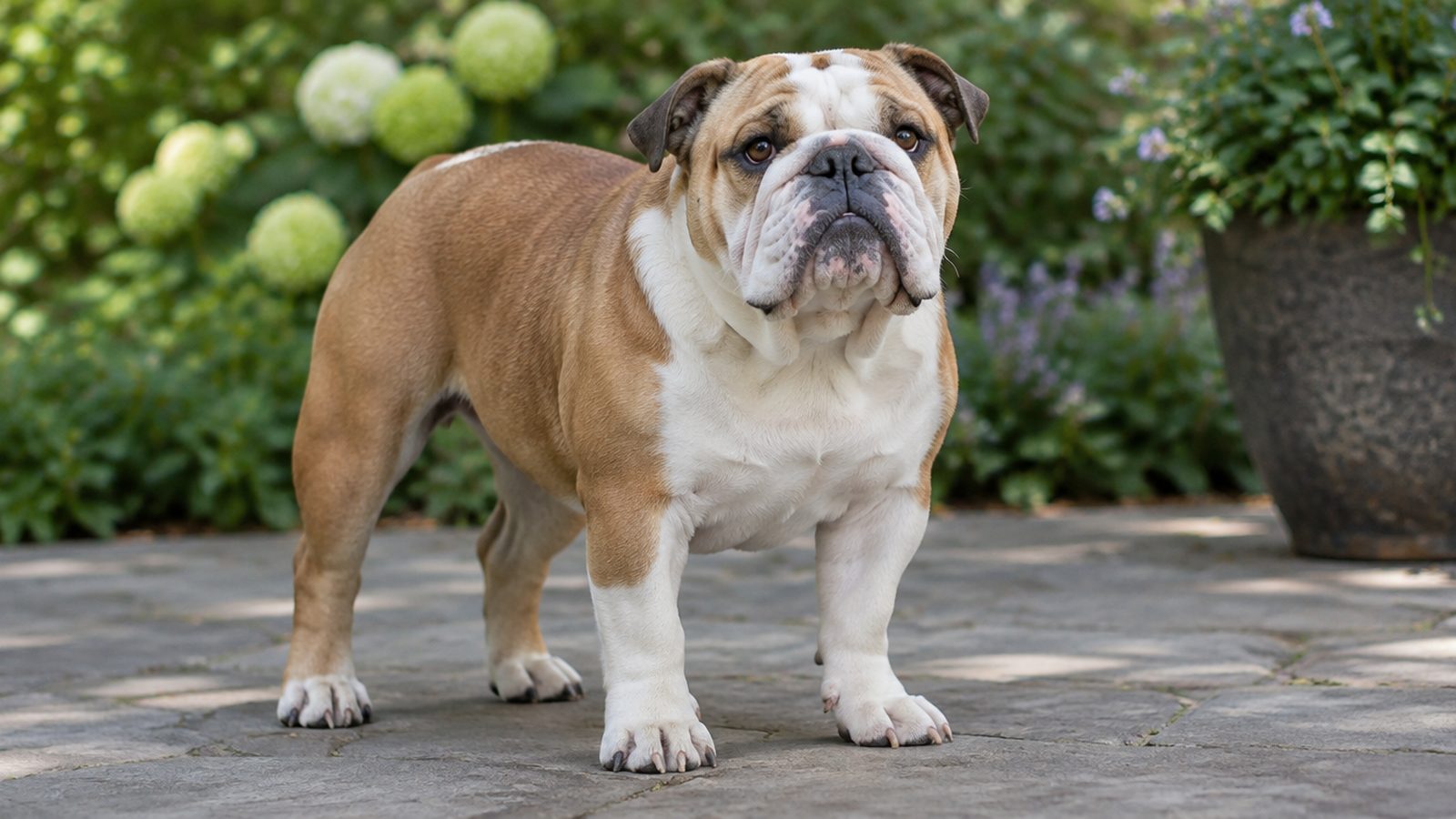
Bulldogs were created in England for bullbaiting. After blood sports were banned in 1835, breeders reshaped the dog into a companion.1 The AKC standard is 14 to 15 inches at the shoulder, about 50 pounds for males and 40 for females.1
The AKC describes a thick-set, low-slung, well-muscled dog with a pushed-in nose and a distinctive rolling gait.1 That is a heavy body on a short frame. The AKC also notes that the short muzzle can make breathing difficult in heat and humidity.1
Which joint and mobility problems are Bulldogs prone to?
Hip dysplasia. The hip joint forms loosely and wears over time. In an analysis of the full Orthopedic Foundation for Animals (OFA) hip registry through April 2015, 77.7% of 515 Bulldogs were rated dysplastic. That was the highest of any breed.4
Read that number with care. OFA data come from dogs whose owners submitted X-rays, so it is not a random sample, and 515 dogs is a small group. The same paper notes that a US veterinary teaching-hospital database put diagnosed hip dysplasia in Bulldogs at 4.4%.4 The two figures measure different things: hip shape on an X-ray, and a diagnosis in a clinic. In UK primary-care records, lameness was recorded in 2.7% of Bulldogs in one year.5 So an abnormal X-ray and a lame dog are not the same thing. Your veterinarian can tell you which applies.
Patellar luxation. The kneecap slips out of its groove. The breed is reported as predisposed, and the Bulldog Club of America recommends a patella evaluation.56
Vertebral malformations. Bulldogs are reported as predisposed to spinal disease linked to misshapen vertebrae.5 We did not find a breed-specific rate we could verify.
| Condition | What it is | When it tends to show |
|---|---|---|
| Hip dysplasia | Loose hip joint that wears | Forms during growth; OFA grades from X-rays7 |
| Patellar luxation | Kneecap slips out of place | No verified breed-specific age5 |
| Vertebral malformations | Misshapen bones in the spine | Present from birth; no verified breed rate5 |
How long do Bulldogs live, and when is one a senior?
A 2024 UK study of more than 584,000 dogs puts the Bulldog median at 9.8 years (95% confidence interval 9.7 to 10.0), against 12.5 for all dogs.2 An earlier UK veterinary-records study found 7.2 years, with females at 7.9 and males at 6.7.5 The AKC gives 8 to 10 years.1 UK data may differ from US dogs.
AAHA defines senior as the last 25% of estimated lifespan.3 Our arithmetic: 9.8 times 0.75 is about 7.4, and the AKC range gives 6 to 7.5. Treat a Bulldog as a senior from age 6 to 7.
What else should a Bulldog owner watch?
- Breathing. Brachycephalic obstructive airway syndrome (BOAS) was recorded in 3.5% of UK Bulldogs in one year, at a median age of 2.7 years. Signs include chronic breathlessness, exercise intolerance, trouble eating and disrupted sleep.5
- Skin. Skin disorders were the most common group, recorded in 28.6% of Bulldogs. Skin fold dermatitis alone was 7.8%.5
- Weight. Overweight was recorded in 8.7%, the third most common disorder.5
What can you do at home?
Keep him trim. OFA notes that weight control reduces the mechanical stress on the hip joints.7 The AKC recommends regular moderate exercise and a careful diet for the breed.1
Manage heat. The AKC advises that very warm days are best spent in air conditioning, and that a Bulldog should not be left in hot sun without shade and water. It also flags stairs and pools as safety hazards.1
Check tonight
When your Bulldog is asleep, sit near him for two minutes and listen. Note how loud his breathing is, whether it stops and restarts, and whether he wakes himself up. Disrupted sleep is one of the signs of airway disease described in Bulldogs.5 Write down what you hear, or record a short video for your veterinarian.
What should you ask your veterinarian?
When to call your veterinarian
Go to a veterinarian or emergency clinic now if your Bulldog is breathing too hard and his tongue hangs out unusually far with a bluish cast instead of the normal pink. The AKC describes this as the sign of an overheated or overexcited Bulldog in trouble.1 Call the same day for breathing that is getting noisier, collapse or near-collapse on a walk, or a leg he will not use.
Questions worth asking:
- Can you assess his airway, and is his breathing normal for a dog, not just for a Bulldog?
- The Bulldog Club of America recommends a cardiac exam, a patella evaluation and a chest X-ray for tracheal hypoplasia.6 Which has he had?
- Are hip X-rays worth doing for him, and what would we do with the result?
- What is his body condition score, and how should I care for his skin folds?
Quick answers
Do Bulldogs get hip dysplasia?
In the OFA hip registry through April 2015, 77.7% of 515 X-rayed Bulldogs were rated dysplastic, the highest of any breed. That is a small, owner-submitted sample, and far fewer Bulldogs are diagnosed with hip problems in clinic data.
How long do Bulldogs live?
UK studies put the median at 9.8 years and 7.2 years, and the AKC gives 8 to 10 years. Females lived longer than males in the UK veterinary-records study.
At what age is a Bulldog a senior?
AAHA defines senior as the last 25% of estimated lifespan. For a Bulldog that works out to about age 6 to 7.
Sources
- American Kennel Club (2026 (accessed)). Bulldog Dog Breed Information
- Scientific Reports (Nature Portfolio) (2024). Longevity of companion dog breeds: those at risk from early death (McMillan et al., Scientific Reports; breed medians in Supplementary Table S3)
- American Animal Hospital Association (2019). Canine Life Stage Definitions (2019 AAHA Canine Life Stage Guidelines)
- Journal of Veterinary Medicine (Wiley/Hindawi) (2017). The Demographics of Canine Hip Dysplasia in the United States and Canada (Loder & Todhunter; breed figures in Supplemental Table 1)
- PLOS ONE (2019). Disorders of Bulldogs under primary veterinary care in the UK in 2013 (O'Neill et al.)
- Bulldog Club of America (hosted by the American Kennel Club) (2019). Bulldog Club of America Health Statement
- Orthopedic Foundation for Animals (2026 (accessed)). Hip Dysplasia
Written by the Tailwise editorial team from the sources above. We are not veterinarians, and this article is not veterinary advice. If something here matches what you see in your dog, talk to your veterinarian.
More years. Better years.