
Why do big dogs have shorter lives than small dogs?
Mainly because large dogs age at a faster rate once aging begins. In a UK study of 584,734 dogs, large breeds had a median lifespan of 11.9 years against 12.7 for small breeds.
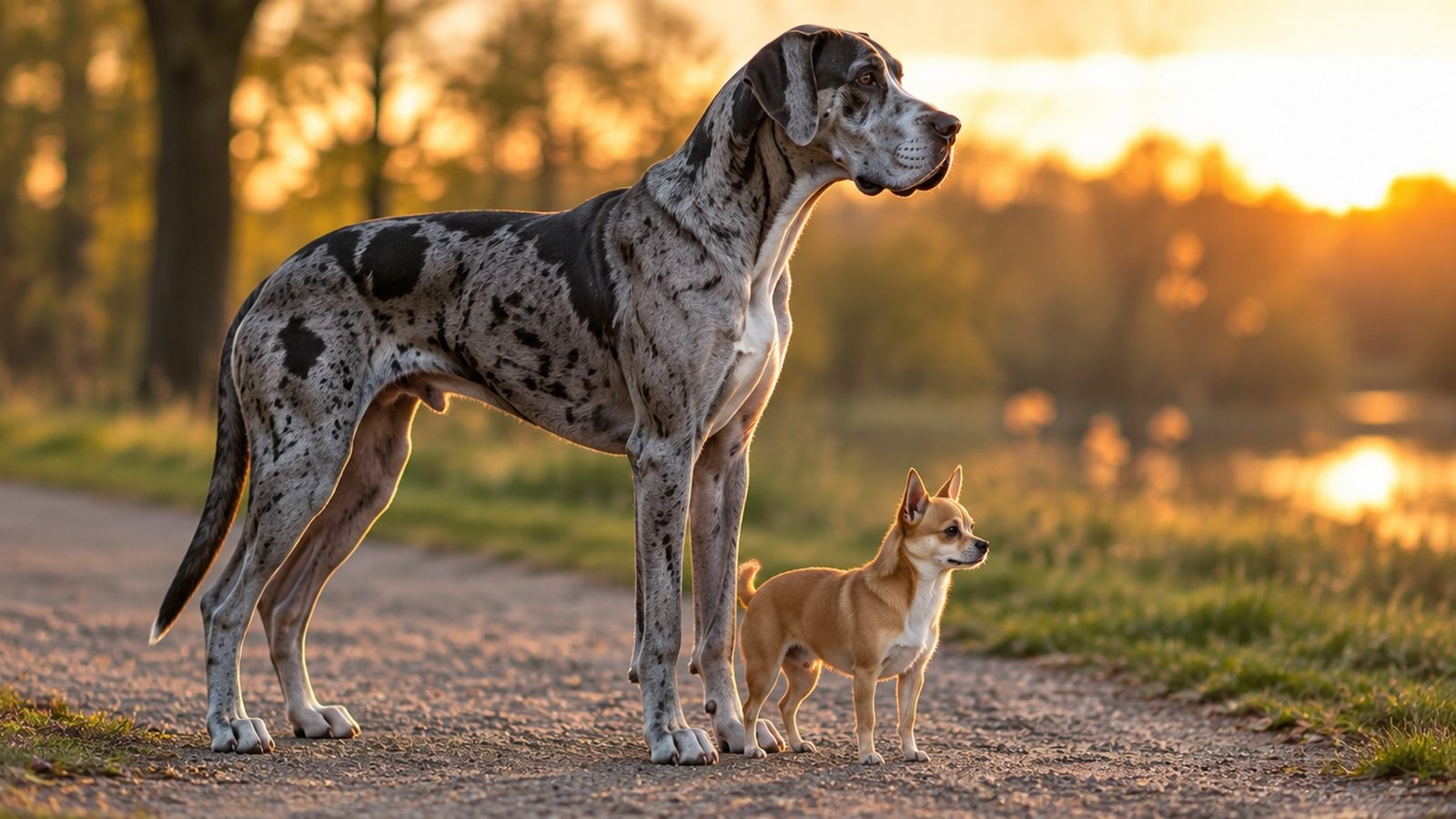
The short version
- A 74-breed analysis found large dogs die younger mainly because they age faster, not because they start aging much earlier.
- UK data on 584,734 dogs: median lifespan 12.7 years for small breeds, 12.5 for medium, 11.9 for large.
- Across mammal species bigger usually means longer lived. Within dogs it is the reverse.
- Keeping a dog at normal weight and starting twice-yearly senior visits on time are the two levers an owner controls.
Big dogs have shorter lives mainly because they age faster once aging begins, not because they start aging much earlier. That is the central finding of a 2013 analysis of 74 breeds published in The American Naturalist.1 The size of the gap is real but often overstated, and part of what happens next is in the owner's hands.
Is it true that bigger dogs live shorter lives?
Yes, on average. The largest recent dataset comes from the UK: 584,734 dogs across 155 breeds, drawn from 18 sources including breed registries, insurers and veterinary groups. Median lifespan by size among purebred dogs was:3
| Size class | Median lifespan |
|---|---|
| Small | 12.7 years |
| Medium | 12.5 years |
| Large | 11.9 years |
That is a difference of under a year between the small and large groups as a whole. The spread between individual breeds is much wider. Across breeds, body size varies by almost a hundredfold and average life expectancy by a factor of two.1
Size is also not the only factor. In the same UK data, flat-faced breeds had a median of 11.2 years against 12.8 for breeds with a medium-length muzzle.3
Why is this the reverse of what happens between species?
Across mammal species, large body size is one of the best predictors of a long life. Within a species the pattern flips, and larger individuals tend to be shorter lived.1 The pattern is especially evident in the dog, because selective breeding has produced such an extreme range of sizes inside one species.
What did the 2013 study find?
The authors, Kraus, Pavard and Promislow, asked where in life the cost of large size is paid. They fitted mortality models to death records from 74 breeds, collected at North American veterinary teaching hospitals between 1984 and 2004.12 There were three candidates:
- Earlier onset of aging. They found no clear link between body size and the age at which aging begins.1
- Higher background risk at every age. Slightly higher in large dogs, but not the main driver.1
- Faster rate of aging. A strong positive relationship with size. This was the driving force.1
Their summary: large dogs die young mainly because they age quickly.1 A commentary in Current Biology reported that body mass explained 44% of the variation in mortality risk between breeds, with lifespan about one month shorter for every 2 kg (4.4 lb) of extra body mass.2
Do we know the biological reason?
Not with certainty. The leading ideas center on growth. Large dogs grow faster and for longer than small dogs and have higher levels of IGF-1, a hormone that strongly stimulates bone and muscle growth. Rapid growth has been associated with more oxidative damage and with a higher risk of some diseases later in life.2
Small breeds carry a distinct variant of the IGF1 gene. Whether that variant influences aging, or is simply a by-product of breeding for small size, has not been established.2 These are associations, not a settled mechanism.
What can the owner of a large dog do differently?
Two things, both earlier than the owner of a small dog would.
Keep the dog lean. A study of 50,787 middle-aged, neutered, client-owned dogs across 12 breeds found that overweight dogs had shorter lives than normal-weight dogs in every breed studied.45 In male German Shepherd dogs the median was 12.1 years for overweight dogs and 12.5 for normal-weight dogs. In male Yorkshire Terriers it was 13.7 against 16.2.4 Weight is one of the few lifespan factors an owner controls directly.
Start senior care on the large-dog calendar. The AVMA considers giant breeds over 90 lb senior at about 6 to 7 years and large breeds of 50 to 90 lb at about 8 to 9. From that point it advises veterinary visits twice a year or more.6 The 2023 AAHA Senior Care Guidelines list blood work and urinalysis every 6 to 12 months for senior dogs.7 If aging runs faster in a big dog, a shorter interval between checks makes sense: less changes between one visit and the next.
None of this is a verdict on any individual dog. A breed median is a midpoint. Half of dogs live longer than it.
Check tonight
Find your dog's last recorded weight and the date it was taken. It is usually on the most recent vet invoice or vaccination record. Write both on a note where you keep the food. If the record is more than six months old, or you cannot find one, that is the gap to close at the next visit. A dated weight is the starting point for every conversation about body condition.
When to call your veterinarian
Call to book a routine visit if your large or giant dog has reached the senior range for its size and has not been examined in the past six months. At the visit, ask three things:
- "What is my dog's body condition score, and what weight should we aim for?"
- "What lifespan do you estimate for this breed and size, and when do you consider the senior stage to start?"
- "Which screening tests do you want, and how often?"
Call promptly for unexplained weight loss, a new lump, or lameness that does not resolve.6
Quick answers
Do big dogs really age faster than small dogs?
Yes. A 2013 study of 74 breeds in The American Naturalist found a strong positive relationship between body size and the rate of aging, and concluded that large dogs die young mainly because they age quickly.
How long do large dogs live compared with small dogs?
In a 2024 UK study of 584,734 dogs, purebred large breeds had a median lifespan of 11.9 years, medium breeds 12.5 years and small breeds 12.7 years. Individual breeds vary much more than these group figures.
Can I help my large dog live longer?
Keeping your dog at a normal weight is the best-supported step. A study of 50,787 dogs found overweight dogs had shorter lives than normal-weight dogs in all 12 breeds studied. Regular veterinary exams from the senior stage on help find problems early.
Sources
- The American Naturalist (2013). The Size-Life Span Trade-Off Decomposed: Why Large Dogs Die Young (Kraus, Pavard & Promislow)
- Current Biology (2013). Ageing: It's a Dog's Life (Selman, Nussey & Monaghan)
- Scientific Reports (2024). Longevity of companion dog breeds: those at risk from early death (McMillan et al.)
- Journal of Veterinary Internal Medicine (2019). Association between life span and body condition in neutered client-owned dogs (Salt et al.)
- Cornell University College of Veterinary Medicine, Riney Canine Health Center. Aging: body condition and life span in dogs
- American Veterinary Medical Association. Caring for senior cats and dogs
- American Animal Hospital Association (2023). Diagnostic Tests and Recommended Frequencies for Senior Dogs and Cats (2023 AAHA Senior Care Guidelines)
Written by the Tailwise editorial team from the sources above. We are not veterinarians, and this article is not veterinary advice. If something here matches what you see in your dog, talk to your veterinarian.
More good years.