
Is green lipped mussel better than glucosamine for dogs?
The dog research leans toward green lipped mussel and other omega-3 sources, and away from glucosamine with chondroitin. The trials are small, and neither one replaces weight control or veterinary care.
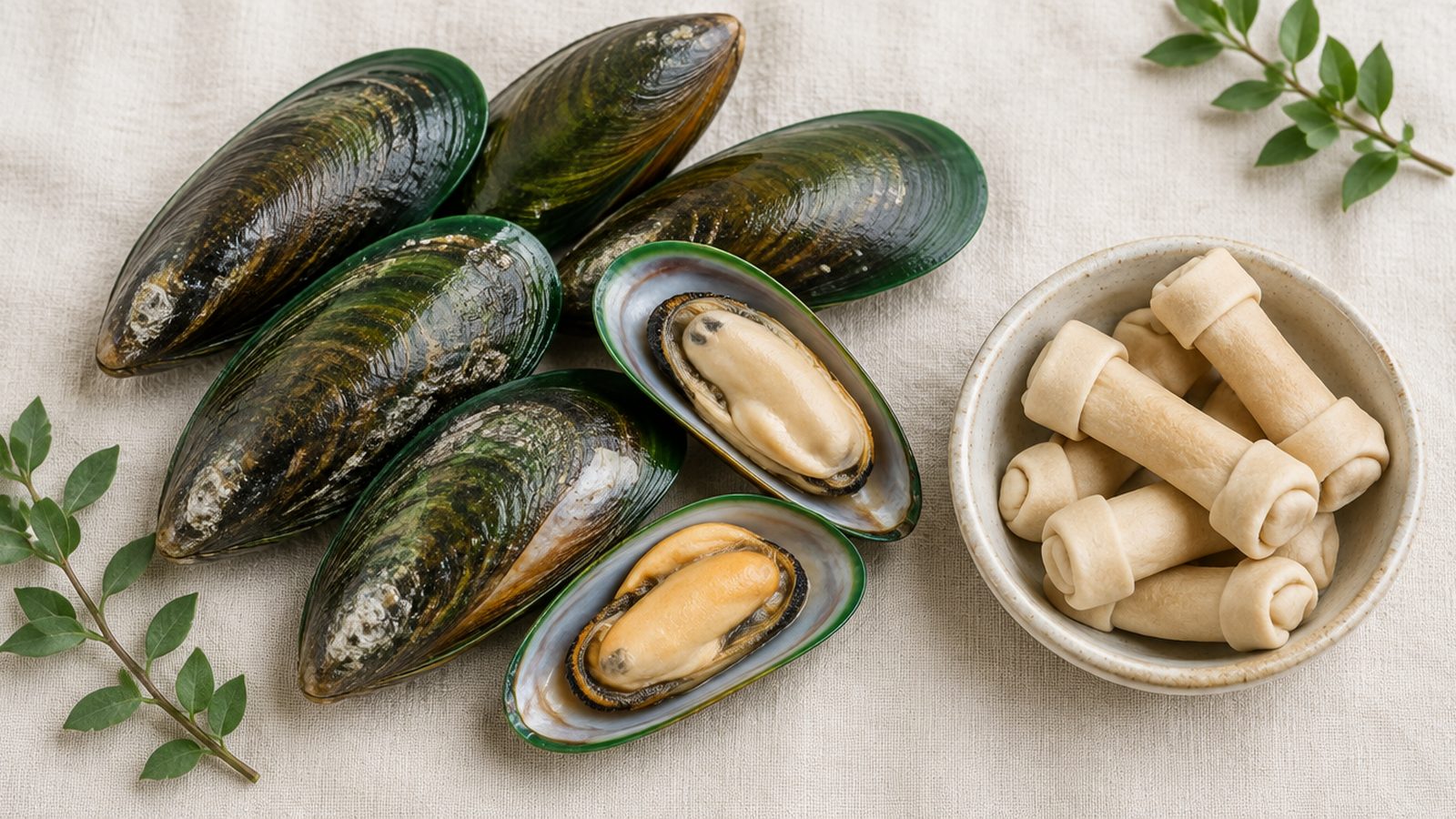
The short version
- Glucosamine and chondroitin are isolated compounds. Green lipped mussel is a whole-food shellfish ingredient that contains glycosaminoglycans and omega-3 fatty acids.
- A 2022 meta-analysis of 72 trials found a marked non-effect for chondroitin-glucosamine products and evident efficacy for omega-3 diets and supplements, the group that includes green lipped mussel.
- In an 8-week trial of 45 dogs, more dogs improved on green lipped mussel than on placebo, but it was less effective than the prescription drug carprofen.
- If your dog is doing well on their current supplement, there is no reason to switch for its own sake.
Green lipped mussel has better support in dog research than glucosamine does, but neither is a fix. The two largest reviews of joint supplements in dogs found the evidence strongest for omega-3 sources, a group that includes green lipped mussel, and weakest for glucosamine with chondroitin.12 Here is what each one is, what was tested, and where the evidence runs out.
What is the difference between glucosamine and green lipped mussel?
Glucosamine and chondroitin are isolated compounds. They are usually sold together, and along with omega-3 fatty acids they are the joint supplements most commonly recommended for dogs.6
Green lipped mussel is a whole-food ingredient made from Perna canaliculus, a shellfish from New Zealand. Researchers describe it as a source of glycosaminoglycans such as chondroitin sulfates, plus vitamins, minerals and omega-3 fatty acids.3 So it is not one molecule. It carries some of the same family of compounds found in a glucosamine and chondroitin product, along with marine omega-3s.3
How any of this works inside a joint is less settled than labels suggest. The American College of Veterinary Surgeons says the exact mechanism by which joint supplements may help is poorly understood.6
What does the research say about glucosamine and chondroitin?
The evidence is weak. A 2012 systematic review in the Journal of Veterinary Internal Medicine looked at 22 papers, 16 of them in dogs, and rated the strength of evidence as low for every nutraceutical except omega-3 fatty acids in dogs.2
A 2022 meta-analysis went further. It pooled 72 trials, 69 of them in dogs, and included nine trials of chondroitin-glucosamine products. The authors reported a "very marked non-effect" for that group and wrote that these products should no longer be recommended for pain management in dogs and cats with osteoarthritis.1
Not everyone in veterinary medicine reads it that way. Cornell's canine health center quotes one of its clinical nutrition professors saying glucosamine and chondroitin "may help slow the progression."4 Opinion is divided. The controlled trials, taken together, are not.
What does the research say about green lipped mussel?
The same 2022 meta-analysis grouped green lipped mussel products with other omega-3 sources. It found "evident clinical analgesic efficacy" for omega-3-enriched diets and omega-3 supplements, and noted that only 2 of 20 trials of omega-3 products showed no effect.1
One trial shows what that looks like in practice, and its limits. Finnish researchers gave 45 dogs with osteoarthritis either green lipped mussel, the prescription anti-inflammatory carprofen, or a placebo for 8 weeks.3
| Group | Dogs improved on vet-assessed mobility |
|---|---|
| Green lipped mussel | 66.7% |
| Placebo | 26.7% |
| Carprofen | 66.7% |
Owner pain scores moved the same way. But the objective measure, how much weight dogs put through the leg on a force plate, did not reach statistical significance, and the authors concluded that green lipped mussel was not as effective as carprofen.3 The trial had 15 dogs per group. That is a small study.
Cornell's summary is that multiple studies have found green lipped mussel helps dogs with arthritis.4 A fair reading: the signal is real and repeated, the trials are small, and different products were tested in different amounts, so one product's result does not transfer to another.
So which one should you choose?
If you are starting from zero, the published evidence leans toward omega-3 sources, including green lipped mussel, over glucosamine.12 If your dog is doing well on what they have, there's no reason to switch for its own sake.
Keep the choice in proportion. ACVS calls a slender body weight "by far the most critical aspect" of managing osteoarthritis.6 The Merck Veterinary Manual describes prescription anti-inflammatories as the most predictably effective treatment.5 A supplement sits behind both. It is not a painkiller.
Check tonight
Watch your dog get up from their bed after the evening rest. In one line, write down what you see: how many tries it took and whether the first few steps looked stiff. Then read the label of any joint supplement you already give and note the first active ingredient. That one-line note is your baseline if you ever change products.
When to call your veterinarian
Call before you start or switch a supplement if your dog limps, struggles to rise, avoids stairs, or already takes medication. Useful things to ask:
- Is this osteoarthritis, and which joints?
- Is my dog at a healthy weight for their joints?
- Would a prescription pain medication do more than a supplement here?
- Is there any reason not to give a shellfish-based supplement alongside what my dog takes now?
What we chose for Tailwise, and why
Tailwise Hip & Joint is a chicken-flavor soft chew for dogs, and it is glucosamine-free by design. After reading the reviews above, we built it around New Zealand green lipped mussel (200 mg per chew), with Boswellia serrata (25 mg), turmeric (25 mg), Yucca schidigera (25 mg) and black pepper (5 mg). Those botanicals have less dog research behind them than green lipped mussel does. The 2022 meta-analysis called the turmeric results conflicting.1 The trials described here used other products, so their results are not results for ours. It is made in the USA in a cGMP facility that is NASC-audited, and it contains shellfish. It is a supplement that supports joint comfort and mobility, not a substitute for veterinary care.
Quick answers
Is green lipped mussel better than glucosamine for dogs?
The published dog research favors it. A 2022 meta-analysis found evident efficacy for omega-3 sources, which include green lipped mussel, and a marked non-effect for chondroitin-glucosamine products. The trials are small, and neither replaces veterinary care.
Does glucosamine work for dogs?
Controlled trials have not shown a clear benefit. A 2012 systematic review rated the evidence as low, and a 2022 meta-analysis of nine chondroitin-glucosamine trials reported a marked non-effect. Some veterinarians still recommend it.
Can I give my dog green lipped mussel and glucosamine together?
Ask your veterinarian before combining supplements, especially if your dog takes prescription medication. Green lipped mussel is shellfish, so mention any known allergies.
Sources
- International Journal of Molecular Sciences (2022). A 2022 Systematic Review and Meta-Analysis of Enriched Therapeutic Diets and Nutraceuticals in Canine and Feline Osteoarthritis (Barbeau-Grégoire et al.)
- Journal of Veterinary Internal Medicine (2012). Systematic Review of Efficacy of Nutraceuticals to Alleviate Clinical Signs of Osteoarthritis (Vandeweerd et al.)
- Evidence-based Complementary and Alternative Medicine (2009). Evaluating Complementary Therapies for Canine Osteoarthritis Part I: Green-lipped Mussel (Perna canaliculus) (Hielm-Björkman et al.)
- Cornell University College of Veterinary Medicine, Riney Canine Health Center (2025). How joint supplements can help with orthopedic conditions
- Merck Veterinary Manual (2024). Osteoarthritis in Dogs and Cats
- American College of Veterinary Surgeons. Osteoarthritis in Dogs
Written by the Tailwise editorial team from the sources above. We are not veterinarians, and this article is not veterinary advice. If something here matches what you see in your dog, talk to your veterinarian.
More years. Better years.